

When we look at the North and South of Europe, that is, at the Germanic and Latin nations, our initial tendency is to see only differences, or even more: stark contrasts. The same is true when we look at North and South America.
In fact, a series of physical, historical, cultural, and behavioural characteristics make common sense oppose one universe to the other, often looking at this diversity through a lens of prejudice, which would counter superiority and inferiority, order and chaos, work and leisure, and so on.
To begin with, Latin peoples are predominantly formed of medium-to-short-stature brown-haired individuals, genetically belonging to the Mediterranean subgroup of the white or Caucasian race, dominated by brown eyes and hair. The Germanic peoples, on the other hand, would be composed largely of blond-haired, clear-eyed, equally white Caucasian individuals, but of the Nordic subgroup. This first ethnic impression may even be statistically proven, but the fact is that the white or Caucasian race is named because anthropological and paleogenetic data attest that the Caucasus would have been the place of origin of the race, and right there, where today are countries such as Armenia, Georgia and Afghanistan, it is possible to find native white people (i.e. not descendants of immigrants) with the most diverse shades of hair and eyes. In Europe itself, blonds, redheads, brown- and black-haired people are found in all nations, from Norway to the island of Malta, from Portugal to Russia.
But common sense also often attributes to Latins a more emotional, anarchic, and at the same time warm and welcoming character, as well as assigns the Germanic people a more rational, rigid nature, a colder and more distant temperament. Of course there is a lot of stereotype in these descriptions, and we will find many exceptions. But remember we are talking about common sense, not scientific data.
Currently, most European states of Latin or preponderantly Latin ethnicity are constituted of republics; the two great exceptions are the kingdom of Spain and the Holy See (yes, the pontifical state is also a monarchy, whose absolute sovereign is the pope). Among the Germanic nations, the majority are monarchies: the exceptions are Germany, Austria, and Iceland.
In the past, a Romance nation, France, was the most important, influential and powerful European monarchy. France, however, was the cradle of the modern democratic and republican model by abolishing the monarchy in 1870. Since then, France has been the greatest example of a republican nation, having inspired even today’s most influential republics, such as the United States of America, for example. By contrast, Great Britain is now the most celebrated example of a constitutional and democratic monarchy.
In this sense, France has also always been the cradle of progressive political ideals and is seen by many as a strongly “left-wing” country (not to be confused with socialist or communist!). On the contrary, England is always seen as a conservative, class-ridden and tradition-bound society — in a word, a “right-wing” country, home to economic liberalism. No wonder, France made the French Revolution, which overthrew the absolutist monarchy, while Britain produced the Industrial Revolution, the origin of modern capitalism.
This predominantly revolutionary and republican trait seems to be reflected even in the national anthems of the Latin countries of both Europe and America, which are almost always live and festive military marches, in allegro or presto tempo. Meanwhile, the anthems of the European and American Germanic states are almost always slow and solemn, in an adagio or largo tempo, as befits a nation of subjects who revere their sovereign.
Historically, the Latin or Romance peoples are so called because they descended from the ancient Romans, speakers of Latin, people that constituted the greater empire of the Antiquity and model of all the modern empires. Latin peoples are, therefore, direct heirs of the Graeco-Roman cultural patrimony, which is the basis of Western Civilisation. On the other hand, the Germanic peoples descend from the ancient Germani or barbarians, so called by the Romans for being seen as culturally inferior peoples, a horde of invading warriors devoid of civilisation.
Much of this view is mistaken, for in fact the Germanic barbarians were initially infiltrating little by little the Roman Empire and being assimilated by the Roman people, even adopting the Latin language. The military invasions that put an end to the Empire only occurred centuries later. Therefore, the present European peoples — excepted, of course, African, Asian and Latin American immigrants from the 20th century and their descendants — are the result of the miscegenation of Norse and Mediterranean, Romans and Germani, Greeks, Slavs, Arabs and Jews.
Nevertheless, still in common sense terms, the direct heirs of progressive ancient Rome, the Latin(o) peoples, are seen as largely underdeveloped, while the ancient barbarians are now overdeveloped; just compare the United States and Brazil, Norway and Portugal. Again, this point of view is relative, since France and Italy are among the richest and most developed countries in the world, just as Brazil is one of the ten largest economies in the world, while poor countries such as Jamaica and Guyana were British colonies and speak English.
But this view of an advanced North and a lagging South has its raison d’être, found in history. Indeed, in the Middle Ages, all Western Europeans, i.e. Latin and Germanic ones, were Catholics, and the concept of nation was very incipient in the face of the extremely stronger notion of Christendom. Even so, one could already note some features that would define the destinies of these peoples. The main European universities were in what I call here in this portal the central nations: France, England, Italy, and Germany. Of the seven liberal arts taught in these centres of study, French and Italian universities (Paris, Bologna) emphasised the teaching of the Trivium (logic, grammar, and rhetoric), while English and German ones (Oxford, Heidelberg) specialised in the Quadrivium (arithmetic, music, geometry, and astronomy). In other words, transposing to the modern university, it can be said that Latin peoples have dedicated themselves more to the arts and humanities, and the Germanic ones to the natural sciences. Not by chance, France is, by excellence, the country of intellectuals (philosophers, sociologists, political scientists), while England, Germany, and the United States are the territory of great scientists and high technology.
This vocation, defined as early as the Middle Ages, led the Romance countries to lead for many centuries the field of the arts (Italian Renaissance, French modern art and fashion, French and Italian cuisine), to such an extent that the artistic heritage of Italy, France and Spain is superior in quality to that of countries like England, Germany and Sweden, for example. On the other hand, the Germanic countries were the first to industrialise and thus to take the lead in terms of scientific and technological production.
But cultural and economic inequality also had a different root, also in the Middle Ages: it was in Germany that Protestantism was born, and for reasons that have little or nothing to do with language or ethnicity (but which are not insignificant in terms of symmetry), it was in the Germanic countries that this new religious confession flourished, practically banishing Catholicism. In fact, the only Germanic country to remain Catholic was Austria. In turn, the Latin world remained Catholic and strongly opposed the advance of Protestantism. The only Latin nation not predominantly Catholic is Romania, which, being situated in Eastern Europe, immediately adhered to the East-West Schism, becoming Orthodox.
The fact is that Protestantism is a doctrine that believes in salvation by works and therefore values work, study, and enterprise. In contrast, Catholicism, by means of the Inquisition, has always hampered progress, persecuted freethinkers, and viewed lay knowledge with suspicion. (Read Max Weber’s The Protestant Ethic and the Spirit of Capitalism in this regard.)
Because France and Italy are central nations in political, economic, and cultural terms, even though the latter is the seat of Catholicism, they have witnessed the intellectual advance and progressive weakening of Church power to the detriment of the bourgeoisie, which has favoured the progress of arts and sciences, unlike the Iberian Peninsula, that was the region where the Inquisition lasted the longest. In addition to its peripheral geographic and political position, it is not surprising that it has long been Europe’s most lagging region. On the other hand, Scandinavia, because it was very late Christianised, was the region where the Catholic Church was less rooted; for that reason, it was the region of easiest penetration of the protestant ideas and of least conflict between Protestants and Catholics, becoming with time, the most developed region of Europe (and of the world!). Suffice it to say that, in the middle of the 18th century, there was no longer illiteracy in these countries.
As a consequence of or perhaps because of this cultural and economic difference, Iberia is still one of the most religious regions of Europe, whereas Scandinavia is where the greatest proportion of atheists are found.
Oppositions and complementarities between the Romance and the Germanic languages
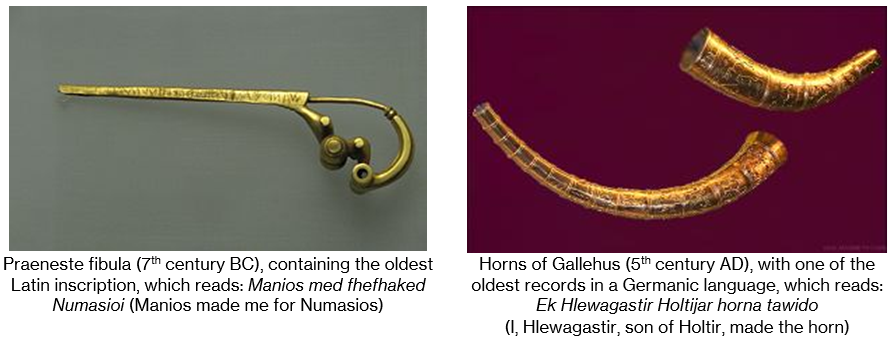
Also between the Romance and the Germanic languages a series of aspects can be found that oppose them like water and wine. But, as in the I Ching, in which the yin and yang forces simultaneously oppose and complement each other, the fundamental differences between the Neo-Latin and the Germanic languages, far from creating an abyss between them, are what unites them. If we consider that they have a common origin, that is the Indo-European ancestry, there would only be three types of evolutionary possibilities: 1) both groups would maintain the same phonetic, grammatical, lexical, etc., features, not being individualised as two linguistic families, but as two branches of the same family, as occurs between the Baltic (Latvian, Lithuanian) and Slavic languages (Russian, Polish, etc.); 2) the two groups would evolve in a totally erratic way, to form two families with some common traits and some distinct ones, as for example between Celts and Greeks, Armenians and Albanians; or 3) the two families would eventually acquire exactly opposite traits, so as to form a negative image of each other. It was precisely this third possibility that occurred. Therefore, the metaphors of the photographic negative or the image reflected in the mirror are so recurrent in this portal.
Phonetic aspects
The Romance languages are characterised by a pronounced phonetic simplicity (at least at first glance): fewer phonemes (25 in Spanish versus 41 in Swedish, for example), simpler and less frequent consonant clusters in counterpoint to the richness of vowel clusters, predominance of words ending in vowels (due to the loss of the final Latin consonants in the passing to the Romance languages) or in “soft” consonants (l, n, r, s). On the other hand, the Germanic languages are famous for their phonetic complexity: a greater number of phonemes, clusters of many consonants, especially in compound words (e.g. G. Selbstmord), predominance of words ending in consonants, especially “hard” consonants (p, t, k, f), thanks to the loss of the final vowels of the Proto-Germanic in the passing to the Germanic languages.
Romance languages also have a tendency to voice and deaspirate consonants (for example, Lat. /p/, /t/, /k/ > Port. /b/, /d/, /g/, deaspiration of Latin aspirated h), which would result in a “lax” pronunciation, whereas the Germanic languages have the opposite tendency, that is, to devoice and to aspirate the consonants (Germ. /b/, /d/, /g/ > G. /p/, /t/, /k/, maintenance of the Germanic aspirated h) resulting in a “tense” pronunciation. Just to cite one example, many Italians speaking Portuguese pronounce casa ‘house’ as gasa, while Germans pronounce gato ‘cat’ as kato. In Germanic languages, the consonants p, t and k are aspirated (in some languages, such as Danish and Norwegian, the phonological opposition is not between voiceless consonants ([p], [t], [k]) and voiced ([b], [d], [g]) but between voiceless aspirated consonants ([ph], [th], [kh]) and unaspirated voiceless consonants ([p], [t], [k]).
The Proto-Romanic (i.e. Latin) phonetics were conservative in relation to the Indo-European, as it retained both Indo-European consonantism and vocalism. The Proto-Germanic phonetics, instead, were innovative in relation to the Indo-European, as it transformed the consonants, in the historical process known as First Germanic Sound Shift, or Erste Lautverschiebung, as well as part of the vowels. The table below, where the sound shifts are in bold, will make these processes clearer.
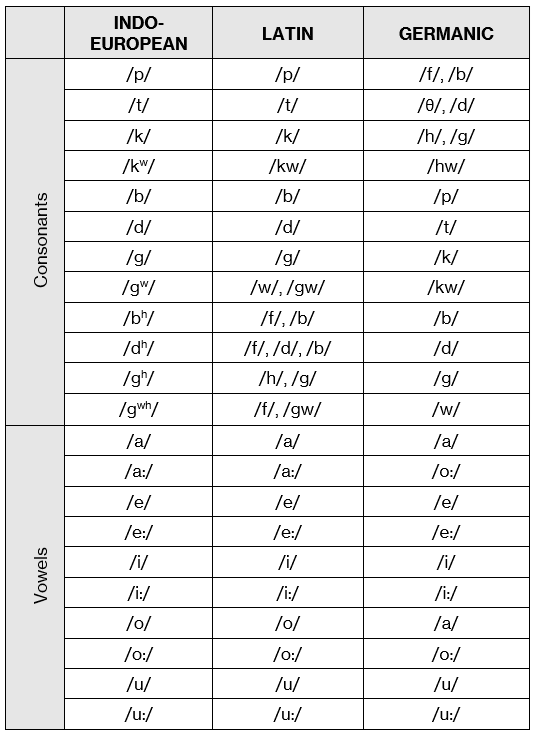
If Latin was conservative and Germanic innovative in relation to Indo-European, in the passage from Latin to the Romance languages and Proto-Germanic to the Germanic languages the opposite happened: Romance languages, except Italian and Romanian, changed the Latin consonants, while the Germanic languages, with the exception of German and Danish, retained the consonants of Germanic. For example, Lat. jocare ‘to play’ gave jouer in French and jogar in Portuguese, but gave giocare in Italian and juca in Romanian. In turn, Germ. *jukan gave yoke in English and åk in Norwegian, but Joch in German and åg in Danish.
Both the Romance and the Germanic languages have undergone a phonetic process very common in all languages, which is the palatalisation of a phoneme when it is followed by a vocalic or semivocalic i (i.e. /i/ or /j/). But, in the case of the Romance languages, what was palatalised was the previous consonant, generating sounds characteristic of these languages such as gli and gn of Italian. In the Germanic ones, there was the palatalistion of the vowels, a phenomenon called Umlaut, from which the German sounds of ö and ü resulted. That is, in the Romance languages we had the following mutations: /k/ + /j/ > /tʃ/, /g/ + /j/ > /dʒ/, /t/ + /j/ > /ts/, /d/ + /j/ > /dz/, /l/ + /j/ > /ʎ/, /n/ + /j/ > /ɲ/. In the Germanic, we had: /a/ + /j/ > /e/, /e/ + /j/ > /i/, /o/ + /j/ > /ø/, /u/ + /j/ > /y/.[1]
In Romance languages, an i or u followed by a vowel results in a diphthong, whereas in the Germanic it results in a hiatus. That is why Spanish separates the syllables of the name of India as In-dia and English as In-di-a.
As for the position of the stress, both Germanic and Latin originally placed it at the beginning of the word, that is, the stressed syllable was always the first. Later, while Germanic maintained this rule, Latin moved the stress to the penult or the antepenult. With this, the Germanic languages have until today a protonic tendency, that is, to put the stress at the beginning of the word (for example, E. every); in compound words, the stress always falls on the first element: E. ghostwriter. The Romance languages have a metatonic tendency, of placing the stress at the end of the word, as in Fr. football); in compound words, the stress always falls on the second element: Fr. tire-bouchons.
As a consequence of this rule, in the Neo-Latin languages the suffixes are usually stressed and the prefixes unstressed; in the Germanic, the suffixes are unstressed and the prefixes are almost always stressed.
Grammatical aspects
If the Romance languages have simple phonetics, in compensation their grammar is complex, whereas the Germanic languages have a more complex phonetics, but their grammar is much simpler. And, in both the Romance and Germanic languages, complexity is greater on the periphery of the system. Grammar is more complex in Iberia and Romania, and phonetics is more challenging in Scandinavia and Iceland.
Portuguese, for example, has three verbal conjugations (most Romance languages have four) and 10 combinations of tenses and moods, with verbs being inflected in three persons and two numbers. The adjectives inflect in two genders and two numbers, and the oblique personal pronouns admit three positions: prosthesis (before the verb: me dá), mesoclisis (in the middle of the verb: dar-me-á) and enclisis (after the verb: dá-me). In contrast, Norwegian verbs have no conjugations, they have only three combinations of tense and mood, and do not inflect either in number or in person. Adjectives have three genders in the singular and none in the plural (in English, they have neither gender nor number), and oblique pronouns are always enclitic. Simple, right?
Even German, who has a reputation for having a difficult grammar, is easier than Portuguese — just compare the thickness of a German grammar with that of a Portuguese one!
On the other hand, Scandinavian languages have long and short vowels, simple and double consonants, different tones that distinguish meaning, opposition between aspirated and unaspirated consonants, as well as sounds that are uncommon in other European languages.
Morphologically, Romance languages prefer to form words by derivation (addition of prefixes or suffixes). For example, Fr. lait + ‑ier = laitier, café + ‑t‑ + ‑ière = cafetière. The Germanic languages prefer composition (juxtaposition of words): E. milk + man = milkman, coffee + pot = coffepot, and so on.
In the syntax, the Latin languages prefer the construction of the type base + adjunct (or determined + determiner). For example, first the noun, then the adjective or modifier: Fr. jour pluvieux, professeur d’anglais. The Germanic prefer the sequence adjunct + base (or determiner + determined): E. rainy day, English teacher. Likewise, in a negative sentence with an oblique pronoun, the Latin languages place the adverb ‘not’ and the oblique pronoun before the verb (Sp. Ella no me vio ‘she didn’t see me’), whereas the Germanic ones place them after the verb and in the reverse order (G. Sie sah mich nicht).
On the other hand, the Neo-Latin languages enjoy a great syntactic flexibility, unlike the rigidity of the Germanic languages. In Portuguese, I can say indifferently O livro que eu tanto queria finalmente chegou, Chegou finalmente o livro que eu queria tanto, Finalmente chegou o livro que tanto eu queria, etc. In English, The book that I wanted so much finally arrived is practically the only possibility of construction.
Finally, the comparative and superlative are formed in almost all cases analytically in the Romance languages (Fr. sage, plus sage, le plus sage); in the Germanic, the synthetic formation predominates: E. wise, wiser, the wisest.
Lexical aspects
Both Latin and Germanic were languages in which nouns, adjectives, pronouns, etc., were inflected in cases. Latin had six cases: nominative (indicative of the subject), vocative (indicative of the vocative itself), accusative (direct object), dative (indirect object), ablative (verb modifier) and genitive (noun modifier). Germanic had four: nominative, accusative, dative, and genitive. Nouns, both proper and common, passed from Latin to the Romance languages in the accusative case (this is, by the way, one of the reasons why the stress usually falls at the end of the words); from Proto-Germanic, they passed to the Germanic languages in the nominative case. This has some implications even on nouns that were not directly inherited, but came as loanwords. For instance, in Latin the name Michael had the stress on the i in the nominative case, whereas the accusative form Michaelem had the stress on the first e). The nominative Michael passed in that same form and accentuation to English and German, but gave Michele in Italian and Michel in French because it came from the accusative Michaelem. This has been a general tendency distinguishing the two language families.
Moreover, practically the whole lexicon of the Romance languages is of Latin origin, either by heritage or loan (only Romanian, for historical reasons, has much of its lexicon coming from Eastern European languages). Meanwhile, most of the lexicon of the Germanic languages is of Germanic origin, either by direct heritage, or by calque, that is, by translation of the morphemes of the Latin words by Germanic equivalents. Only English, also for historical reasons, has a number of words of Latin origin far higher than that of its sister languages.
One last curious fact: due to the fall of posttonic syllables in the passage from Latin to French, almost all French words are oxytonic; in Italian, due to the maintenance of the final Latin vowel, almost all words end in a vowel and few are oxytonic, many of which are proparoxytonic. In English, due to the loss of word endings in the passage from Middle to Modern English, many words have become monosyllables or, at least, short; conversely, in German, the juxtaposition of words in compounds produces many long and even mile-long words, such as Rechtsschutzversicherungsgesellschaften. |
Conclusion: yin and yang
As I said at the beginning of this article, all these differences in behaviour between the two families of peoples and languages, far from representing the total absence of relation, as common sense assumes, supported as always by a superficial and unfounded analysis, represent, on the contrary, the very basis of the notion of mirroring. In other words, it is from all these systematic differences in all sectors of the life of these peoples (historical, geographic, linguistic, social, cultural), that the synchronicities object of this portal are established, because between two simply different photos — say, that of a horse and that of a tree — no connection can be established, just as between two absolutely identical photos (that is, two copies of the same photo), the point-to-point identity means nothing: the connection is total, but is trivial, since both proofs came from the same negative. In contrast, the overlapping of a photo and its negative produces a match: point-to-point coincidence between two objects we didn’t know that were related until we made the overlap.
Between Celts and Slavs, or between Chinese and Afghans, we have a situation like the photos of the horse and the tree; between Celts and Celts, or between Chinese and Chinese, we have the identity in the mathematical sense of the term (A = A, B = B, etc.). In turn, between the Latin and the Germanic peoples, we have the photo and its negative, the object and its reflection in the mirror.
__________
[1] Romanian is the only Romance language having Umlaut. In contrast, Dutch is the only Germanic language not to have it.