
Correspondences between Romance and Germanic languages
We have, in short, ten Romance languages (Portuguese, Galician, Spanish, Catalan, Occitan, French, Venetian, Italian, Romansh and Romanian) and ten Germanic (Norwegian, Neo-Norwegian, Swedish, Danish, Scots, English, Dutch, German, Luxembourgish and Icelandic).
Note: if we consider that some of these languages are in decline, suffocated by the majority languages of their countries, we actually have seven Romance languages (Portuguese, Galician, Spanish, Catalan, French, Italian, Romanian) and seven Germanic (English, Dutch , German, Danish, Swedish, Norwegian and Icelandic). |
The thesis that I advocate here is that there is a one-to-one correspondence between the languages of one family and those of the other. The specularity of these languages, as well as between their countries, is a unique phenomenon in the world, throughout history: nothing similar occurs between any other families of peoples, countries or languages. Why it happens precisely in Western civilisation, especially in its European core, I cannot say. In any case, as the demonstration of this specularity will be done in other articles, for now I limit myself to presenting the network of correspondences between the languages, which is as follows:

Also among the semi-standard languages (dialects and Creoles) we can establish a mirror match. In most cases, it is a much more geographical than properly linguistic correspondence, although it is also sometimes possible to find similarities between the languages. But, being few, it takes caution not to confuse mirroring resulting of synchronicity with mere coincidence. Matches would then be as follows:

In certain specific aspects, a language can present analogy relationships with any other than its mirror. For example, Romanian, a mirror image of Icelandic, has at the same time some characteristics of Dutch. On the other hand, Spanish, although peering Swedish, has certain similar characteristics to English (before the reader finds this statement absurd, I promise timely to publish a separate article on this point). English is the mirror of French, but also has symmetrical features with Italian, as well as German, the mirror of Italian, has symmetrical features with French. These four languages thus establish vertical and diagonal relations.
Here it is necessary to establish a gradation between the types of mirroring. Two languages may have similarities and/or analogies with each other of synchronistic nature[1], both in relation to their history (internal and external) and their structure (phonetic, phonological, morphological, syntactic, lexical, orthographic). By internal history of the language we mean the evolution of the linguistic system; the external history of the language is largely the history of the peoples who speak it, especially in relation to events that have determined changes in the course of linguistic evolution, such as foreign invasions, territorial annexations, external cultural influences, etc.
From this point of view, we would have three situations:
- strong mirroring: many synchronicities both in the history and the structure of the language;
- medium mirroring: many synchronicities in history, but few in language structure, or few synchronicities in the history, but many in the structure of the language;
- weak mirroring: few synchronicities in both the history and the structure of the language, or many synchronicities in history, but almost none in language structure;
- For example, the mirroring between French and English, or between Italian and German, is strong. Among the Iberian and Scandinavian languages there are many historical symmetries, but structurally the common points are less frequent and less obvious than in the four languages mentioned above. Among Venetian and Dutch there are many historical synchronicities (analogies between the history and geography of Veneto and the Netherlands, as well as their relative closeness to Italian and German, respectively), but few structural analogies.
Therefore, each family has ten standard languages, of which six have a single, unambiguous mirror language, and the rest have more than one.
Representing the strong specular relation by a continuous arrow, the medium by a dashed arrow and the weak by a dotted one, the correspondence would be this:

I am calling here central languages (within the rectangle in the diagram above) the four languages that have strong vertical and medium diagonal mirrors (French, Italian, English and German). These languages are, by the way, the languages of the four nuclear nations of European Civilisation: France, Italy, Great Britain and Austria-Germany (see Some geographical evidences of supersynchronicity in Europe). On the vertical and diagonal relations between these languages, check the section The inverted symmetry of the Western languages later on. The other languages and the nations from which they originate will be called peripheral languages.
It is also possible to establish correspondences between the dialects that, due to their importance, may become languages (some already claim it). For example, Sardinian, language as archaic as Romanian, is spoken on the island of Sardinia in the Mediterranean Sea; at the same time, Faroese, with close characteristics to Icelandic, is spoken in the Faroe Islands in the North Sea. (Here we have a linguistic and also geographical analogy.)
Italy is linguistically divided into two dialectal regions, Upper Italy and Lower Italy, by the imaginary La Spezia-Rimini line, so called because it connects these two cities and separates north from south. The area between this line and another, Massa-Senigallia, further south, marks the transition between the two Italys. The High-Italian dialects have phonetic characteristics closer to French and the Iberian languages, while the Low-Italian ones are closer to Romanian. The most famous Italian dialect is Neapolitan (in Lower Italy).
Similarly, Germany is divided into Upper Germany and Lower Germany. Two lines cut through the German territory: the Speyer[2] line and the Benrath line. North of the first, is the Low German area; south of the second, the area of High German; between the two, the transition zone. The country’s main dialect is Low German, spoken to the north. Despite the name, phonetically Low German is more like English and Dutch.
Italian and German have dialectal varieties in the New World, resulting from colonisation by immigrants in the 19th century. Italian has Talian or Rio Grande Venetian in southern Brazil (note that, although currently Venetian is recognised as a standard language, Talian is seen as an Italian dialect) and Chipilo region, Mexico; German has Hunsrückisch or Riograndenser, also in southern Brazil, and Pennsylvania German in the United States.[3]
As the region of Veneto, Italy, has many features in common with the Netherlands (Venice and Amsterdam are cities between canals, so much so that the latter is called “Venice of the North”;[4] both regions had in the past maritime vocation; Venice was a rich republic of traders later annexed to Italy, while the Netherlands were a German province that later became a rich republic of traders — all these analogies will be dealt with in a separate article on geography), it makes sense to establish a linguistic correspondence between Dutch and Venetian, as well as between Frisian and Friulian, although they are weak correspondences, that is, based on a number of coincidences less abundant than in other cases.
It is worth, in any case, mentioning here a common feature between Venetian and Dutch: the sch group, which in German is a single phoneme [ʃ], sounds in Dutch as two: [sx] (i.e., the language pronounces separately s and ch); also, the sc group sounds like [ʃ] in Italian, but as [stʃ] in Venetian, which indicates analogously the separate pronunciation of s and c (in some words, Venetian spells s-c in place of sc).
South of France, in the border region with Occitania, is Franco-Provençal; northwest, in Brittany (also called Little Britain) and Cornouaille, Breton is spoken, which belongs to the Celtic family. To the north of Britain, in Scotland, there are Scots and Gaelic, a Celtic language; southwest (Wales and Cornwall) respectively Welsh and Cornish, both Celtic, are spoken.
The Provence region of southern France has many features in common with Scotland, northern Britain. In addition to being both more rural areas (and famous for their countryside), they have different languages and cultures, which has generated, from time to time, autonomist or separatist movements. In fact, both regions were late annexed to their respective countries, which has kept alive a certain flame of nationalism.
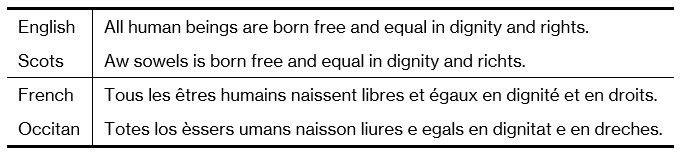
Regarding the languages of France and Britain, we have an inverted image: Occitan south, Scots north; Breton northwest, Welsh/Cornish southwest. Check out the illustration.
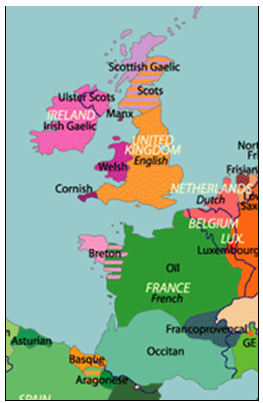 Source: www.eurominority.org
It can be said that the Iberian languages are much closer to each other than the other Romance languages. Indeed, a Portuguese, a Galician and a Spaniard can understand one another perfectly (Catalan is the farthest from the three). The Scandinavian languages are also closer to each other than the other family members. And, similarly, Swedish is more intelligible to Norwegian and Neo-Norwegian than to Danish. Both the Iberian and the Scandinavian languages are technically dialects of the same language (Iberian Romance and Old Norse, respectively) that, for historical and political reasons, assumed the role of national languages.
Iberian Romance was divided into Western (which gave rise to the ancient Galician, also called Galician-Portuguese, Castilian and Asturian-Leonese) and Eastern, which gave rise to Aragonese and Catalan. Similarly, Old Norse was divided into Western (from which came Norwegian, Faroese and Icelandic) and Eastern (Swedish and Danish).
Finally, the relationship between Ladino and Yiddish, both vehicular languages of the Jewish community, is evident. The name Ladino derives from Spanish and means ‘Latin’; Yiddish, resulting of G. jüdisch, means ‘Jewish’.
__________
[1] That is, more numerous than would be expectable if it were a case of mere chance or the result of known and trivial causes, such as kinship or mutual influence.
[2] It may be a coincidence, but the name Speyer resembles Spezia, doesn’t it?
[3] A clarification: some authors use the name Talian not only to the dialect spoken in southern Brazil, but also to designate the own Venetian language. In this case, they do the same as the English-speakers when calling the language of Netherlands Dutch, which literally means ‘German’. Incidentally, as Talian is a corruption of ‘Italian’, Dutch comes from Deutsch, ‘German’. And just as the term Talian designates not Italian but Venetian, the Pennsylvania Dutch is not a Dutch dialect spoken in the United States, but a German dialect.
[4] A further curiosity: surrounded by canals and located on the coast, both cities face the threat of invasion by the sea. Therefore, the land where Amsterdam is located, which is below sea level, was centuries ago surrounded by dikes. Venice, which is already feeling the consequences of rising sea waters due to global warming, is also building dikes.