
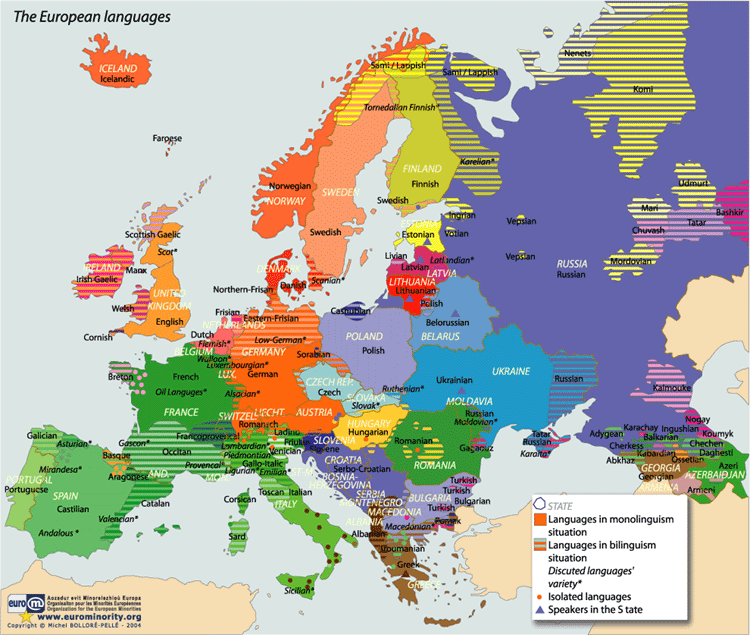
 Source: www.eurominority.org
Every human communication system made up of words and grammar is a language. It doesn’t matter if it is spoken by millions or by a few dozen people, it doesn’t matter if it has a long literary tradition or is only used orally, it doesn’t matter if it is used in formal situations or only in informal chats. However, it is common to divide, much more politically than linguistically, languages in standard languages (also called literary languages, culture languages or civilisation languages) and dialects. But before we speak about the Romance and Germanic languages and their symmetries (i.e., about the standard languages of these families and their dialects), we’d rather define what is a standard language and a dialect. As we shall see, the similarities between the two families take place language by language and also between dialects.
A standard language is a language provided with written expression at formal level and systematic use in daily communication, in work and trade relations, official documents, the mass media (books, newspapers, magazines, radio, TV, internet), not restricted to a small number of locations, and above all, expressing a feeling of ethnic or national identity by the speakers, regardless of whether or not it is officially recognised. Put simply, a standard language is a language spoken by all or large part of the population of a country, which not only produces written texts, but texts of great social importance, whether because they are widely spread, or because they have formal, solemn or official character.
In contrast, a dialect is an everyday usage language, whether or not it has a written form, but without a literary tradition, regardless of whether or not it is officially recognised. A dialect is spoken at home, with friends, poems and popular songs can be written in it, and sometimes the older and less educated have it as the only language. Nevertheless, given its informal character, a dialect does not produce “important” texts. Moreover, it is always spoken by a minority of the population, and this minority usually can also speak the dominant language in the country. It is in this standard language that this minority expresses itself in formal situations. It may even happen that one or more dialects are spoken by the majority of the population, but even so, this dialect retains the character of informal and domestic language.
As a natural result of this distinction, standard languages are standardised, which means that, in addition to a popular expression, they have a standard norm, generally regulated by an academy.
Every language was born as a dialect and, over time, thanks to the political, economic or cultural importance of the community that spoke it, became a prestigious and state language. Some Western languages have become standards as early as the Middle Ages; others only recently; some still struggle to be recognised as such; and finally, many have remained only as dialects.
So, we could admit a third category intermediate between standard language and dialect: it would be the semi-standard language, a language that has formal written expression, but whose usage is restricted to certain kinds of texts. For example, there may be multiple sites in that language, and even a full version of Wikipedia, but not printed books, newspapers, magazines, radio or TV programmes, nor does the law allow official documents to be written in it.
Semi-standard languages became frequent after the advent of the internet, as many dialects, regional and minority languages (see below) began to produce documents in digital format, adopting an orthographic standard for this purpose.
In short, language is a linguistic fact, standard language and dialect are political facts. As linguist Max Weinreich rightly said, “a language is a dialect with an army and a navy”.
What characterises a standard language is its systematic writing, that is, a significant production of books, newspapers, magazines, websites, official documents, radio and television broadcasts, etc., which, obviously, presupposes that the language in question is used also in the speech of a representative population, since a speech restricted to a small group of villages would hardly produce abundant literature. (What I am calling literature here is the set of written texts of a formal character, therefore it is not restricted to fiction literature — novels, short stories, etc.) In addition, a standard language — and therefore a culture language — is, first of all, the native language of some people and, as such, spoken in the everyday life of this people. Therefore, a language need not be officially recognised by any government to be a standard language.
On the other hand, a dialect, although it may be spoken by many individuals in a vast territory, is not a standard language because it only has an oral expression or has no formal written expression, as, for instance, Neapolitan, which is only written in tablets on the façades of canteens or in the lyrics of canzoni. For the same reason, the native languages of Africa, Asia and America are also often called dialects in relation to the European languages of the colonisers of these regions. However, nowadays the linguistics textbooks and dialectology catalogues classify them as regional or minority languages.
In short, we can adopt the following criteria to define a language as a standard and thus distinguish it from its dialects. A language will then be considered a standard if it meets at least one of the following criteria:
1) it is or was an official or co-official language of some nation;
2) it has a long literary tradition, that is, the production of both fiction texts (poems, short stories, novels) and formal non-fiction texts (official documents, technical, scientific, legal, journalistic, religious texts, etc.);
3) it exerts or has exerted great cultural influence on other languages;
4) it is commonly spoken in everyday life, not only in domestic and informal situations, but also and above all in public social interactions (work, commerce, between neighbours and even between strangers);
5) it is widely used by mass media (newspapers, magazines, books, radio, television, the internet).
Romance standard languages and dialects
If we think only in terms of languages that have official character and a long history of literary production, we will find that there are only five Romance or Neo-Latin standard languages: French, Italian, Spanish, Portuguese and Romanian. On the other hand, scientific studies in Romance philology recognise dozens of languages within the context named by specialists Romania (not to be confused with the country Romania). Applying the above defined criterion to distinguish standard language and dialect, it will result that, in addition to the five aforementioned languages, also Catalan, Galician, Occitan (or Provençal), Venetian and Romansh are languages. Catalan, Galician, Occitan and Venetian are languages that had great importance in the Middle Ages. In Catalan the great mystic Ramón Llull and several troubadour poets expressed themselves; Galician, initially in the form of Galician-Portuguese, is the language of the songs that mark the beginnings of Portuguese literature and therefore the language that originates both modern Portuguese and Galician; Provençal was a very important language due to the poetic production of its troubadours and minstrels, which influenced the whole of European literature in the medieval period. Finally, Venetian had great prestige at the time of the Venetian Republic, known as The Most Serene (9th-18th centuries), becoming a lingua franca in the Mediterranean at the time of the Crusades.
Later, these languages have declined in importance as the territories where they were spoken were politically subjugated: Galicia and Catalonia by Spain in the 15th century; Provence by France around the same time; Venetia annexed first to Austria and then to Italy. Only since the 19th century and especially in the 20th century have they once again enjoyed the status of literary languages.
On the other hand, Romansh, for centuries considered a mere Italian dialect, has been growing in importance as it became one of the four official languages of Switzerland in 1938.
There are many Romance dialects, but the most important to be mentioned are: Neapolitan (Low Italian), Friulian and Sardinian in Italy; Franco-Provençal in France; Asturian, Andalusian and Valencian in Spain; and Mirandese in Portugal. There is also a language used by the Jews of the Iberian Peninsula called Ladino, which looks a lot like Spanish (strictly speaking, it is a Spanish adapted by the Jewish colony of Iberia).
Another aspect to note is that many of these languages are spoken in more than one country, within or outside Europe (transnational languages), and in some cases develops in each country a different language variety, as in the case of British and American English. I shall deal with this point later.
Finally, the European colonial expansion made European languages become official languages of countries outside Europe (i.e., of Americas, Asia, Africa and Oceania). The transcontinental Romance languages are French, Spanish and Portuguese.
Colonisation also made these languages serve as the basis for the formation of Creole languages, i.e., resulting from the linguistic contact of two or more peoples of different languages. Creole languages, spoken outside Europe, have a lexical base from some European language and simplified grammar and phonetics.
In the Romance context, languages worthy mentioning for being co-official languages in their countries are: Haitian Creole, or Créole, of French base, in Haiti, Cape-Verdean Creole, in Cape Verde, and Papiamento, in the Netherlands Antilles, both of Portuguese base. There are no Spanish-based Creoles.
Germanic standard languages and dialects
According to the same criteria of literary tradition and official recognition, there would be seven Germanic languages: English, Dutch, German, Danish, Swedish, Norwegian (also called Bokmål) and Icelandic. However, there are three other languages with standard status: Scots, Luxembourgish and Neo-Norwegian or Nynorsk. The latter had great vitality in the Middle Ages, when it was known as Landsmål (country language), as opposed to the court language, Riksmål (royal language). Both produced literature until Riksmål, influenced by Danish (Norway was annexed to Denmark in the late 14th century), became Dano-Norwegian, or Bokmål (literary language). Landsmål would rise again in the 19th century as Neo-Norwegian. I will speak in more detail about this process further, also because the evolution of Bokmål-Nynorsk presents a series of specularities in relation to Portuguese-Galician.
Scots is spoken in Scotland (Great Britain) and was once the official language of the ancient Kingdom of Scotland. Luxembourgish, originally a High German dialect spoken in the Grand Duchy of Luxembourg, has been recognised as an official language (alongside German itself and French) since 1984.
It must be said that, while Galician, Catalan, Romansh and Neo-Norwegian are languages on the rise, Occitan, Venetian and Scots are currently in decline, losing ground respectively for French, Italian and English. In a way, this puts them in the semi-standard language level.
Among the most important Germanic dialects are to consider Low German in Germany, Frisian in the Netherlands, Faroese in Denmark, and Østnorsk and Høgnorsk in Norway. There is also the language of German Jews, Yiddish, whose base is German itself.
The Germanic transcontinental languages are English, Dutch and Danish.
Among the Germanic Creole languages with co-official status in their countries are: Jamaican Creole, or Patois, of English base, in Jamaica; Sranan Tongo in Suriname and Afrikaans in South Africa, both of Dutch base. There are no Danish-based Creoles.
Noteworthy points:
|
Dialectal divisions of the Romance and Germanic languages
By coincidence or perhaps synchronicity, both the Romance and Germanic languages are divided by linguists into three branches or subgroups: Western, Eastern and Northern. The main criterion for this division is phylogenetic, that is, the position of each language in the family tree, but specific phonetic characteristics are also taken into account. In the Romance case, the Iberian languages (Portuguese, Galician, Spanish, Catalan), Occitan, Venetian and Romansh are part of the Western branch; of the Eastern branch do Italian and Romanian take part; and the Northern branch is represented only by French. In fact, there would be only two major groups: an Eastern, whose main phonetic feature is the conservation of the stop consonants of Latin (p, t, c, b, d, g), and a North-Western one, which changes these consonants. However, as French changed them differently from the other languages of the group, the so-called North-Western group is subdivided into Northern and Western.
Isn’t it amazing that the Germanic family is divided in exactly the same way? There was in the past an Eastern branch, whose only attested language is Gothic (now extinct), and a North-Western branch, which is divided into Northern (Scandinavian languages — Norwegian, Neo-Norwegian, Swedish and Danish — plus Icelandic) and Western (English, Scots, Dutch, German, Luxembourgish).
Both the Northern Romance and the Eastern Germanic branches consist of a single language (French and Gothic, respectively).