
Portuguese-Galician vs. Bokmål-Nynorsk
Strictly speaking, Portuguese and Galician are dialects of the same language. They have a common origin in the Galician-Portuguese or Old Galician, the language spoken in north-western Iberia until the 14th century.[1] After that, there was a split in which the language of the territory of Galicia, to the north, annexed by Spain in 1230, underwent a great influence of Spanish, and the language further south (Kingdom of Portugal) became Portuguese. This became the national language of Portugal and has always had autonomous life. In contrast, the language of the north, Galician, survived for centuries only as a dialect and only in the 19th century, more precisely from 1833, with the nationalist movement called Rexurdimento (Resurgence), resumed the plenitude as a literary language. After being repressed by the Franco regime, it was recognised as one of the official languages of Spain.
However, some authors[2] consider that the language spoken in the northwest of the Iberian Peninsula from the beginning was Galician and that Portuguese would then be a derivation of this.
Similarly, Bokmål and Nynorsk are Norwegian dialects, originated from the same ancestral language, Old Norse.[3] With the annexation of Norway by Denmark from 1380 to 1814, Norwegian was greatly influenced by Danish, going to be called Dano-Norwegian, Riksmål (royal language) or Bokmål (book language). Meanwhile, the Norwegian spoken in the countryside (Landsmål ‘language of the country’) kept its own characteristics, but remained for centuries just as a group of dialects. In the 19th century, amid a wave of nationalism, linguist Ivar Aasen created in 1853, on the basis of Landsmål, the new Norwegian or Nynorsk. Today, both languages, Bokmål and Nynorsk, are official in Norway.
And, just as in the case of Galician-Portuguese, there are authors who call Old Norse as Old Icelandic or Old Norwegian; therefore, just as Galician would be older than Portuguese itself, Old Norse is older than Norwegian, which descends from it.
Thus, it can be said that in the beginning there were only old Galician and old Norwegian. In south-central Portugal, Galician, perhaps influenced by the Mozarabic dialects of the south of the peninsula, evolved into Portuguese. And in south-central Norway, Norwegian was influenced by Danish and evolved into Dano-Norwegian, or Bokmål. Meanwhile, old Galician and old Norwegian were relegated for centuries to the status of rural languages, without a written expression, spoken only in domestic settings. In the 19th century, both re-emerged as literary languages, modern Galician and Neo-Norwegian. Note the dates of the resurgence of Galician and Nynorsk: 1833 and 1853, respectively.
Like Portuguese, Norwegian has two spellings, the Bokmål and the Riksmål. And just like Portuguese, who made its orthographic unification in 2009, Norwegian sought to unify the spelling in a reform in 2005. But the great orthographic reform of Portuguese, which abandoned the etymological writing, occurred in 1911, a year after the proclamation of the republic in Portugal. And the great reform of Norwegian, which moved it away from Danish spelling, occurred in 1907, two years after the independence of Norway.
Just as there are two varieties of Galician — traditional (or isolationist) and reintegrationist — the first of which is the official and most widespread, there are also two varieties of Neo-Norwegian, Nynorsk and Høgnorsk, the first being recognised as official and the most widespread. In fact, the main difference between both the two types of Galician and of Neo-Norwegian is the spelling, because traditional Galician adopts a Spanish-inspired system and reintegrationist a Portuguese-inspired one, as well as Høgnorsk, more traditional, rejected the 1917 reforms.
To make the parallelism between these languages even more evident, see the following diagram:
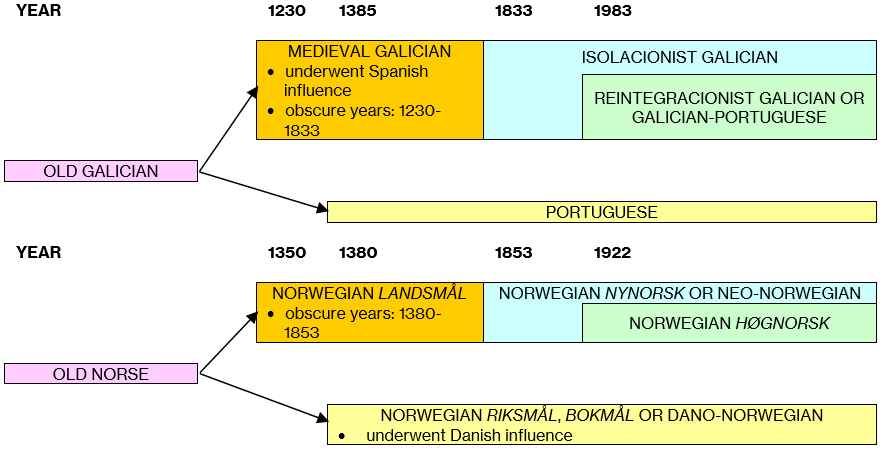
An interesting fact: Norway is called Norge in Bokmål Norwegian and Noreg in Neo-Norwegian. In a certain region of Portugal, a language similar to Portuguese (actually, a dialect of it) called Mirandese is spoken. Thus, the country also has two names: it is called Portugal in Portuguese and Pertual in Mirandese.
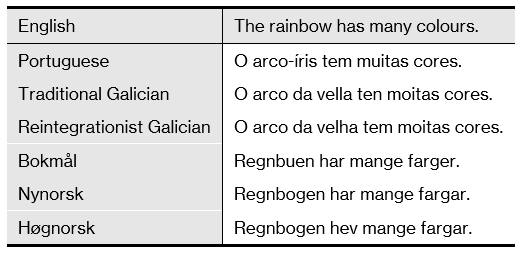
Both languages, Galician and Neo-Norwegian, are offshoots of a single — Galician is regarded by many as a Portuguese dialect, and Nynorsk, as a Norwegian one, although, as I said, Galician is older than Portuguese, just as Riksmål, the basis of Neo-Norwegian, is older than Bokmål. Both flourished in the Middle Ages and, between the 14th and 19th centuries, went through a period of obscurity. Both resurfaced through the work of intellectuals and by nationalist movements. Both are co-official languages in their countries and both have two varieties, one official and the other not. On the other hand, while on the Romance side, Galician underwent great Spanish influence, on the German side, it was Bokmål which underwent the influence of Danish.[4]
In fact, for political reasons, Spanish, that is, Castilian, was the language of culture throughout the Iberian Peninsula from the 15th to the 17th century, being widely spoken in Portugal and Catalonia and feeding these languages with its vocabulary, to which Latinisms and Gallicisms arrived first. For the same reasons, Danish was the dominant language in Scandinavia at more or less the same period, having influenced the lexicon and spelling of the other languages of the peninsula.
It is also worth noting that the same controversy that disputes whether Portuguese and Galician are two different languages or two varieties of the same language also affects Norwegian in the face of Neo-Norwegian.
In short, there was in the Iberian Peninsula between the 5th and 11th centuries an offshoot of Vulgar Latin called Iberian Romance, whose western branch included Galician-Portuguese, Asturian-Leonese and Castilian, and whose eastern branch was formed by Aragonese and Catalan. Galician-Portuguese maintained its unity until the 14th century, when the language of the Kingdom of Portugal distanced itself from Galician, taking on its own character, and Galician lost its prestige as an autonomous language and was greatly influenced by Castilian with the annexation of Galicia to the Kingdom of Castile (later the Kingdom of Spain), remaining for centuries as a rural language, only re-emerging as a literary language in the 19th century.
Analogously, there was in Scandinavia from the 5th to the 11th century a language descended from Common Germanic called North Germanic or Proto-Nordic, equally divided into a western branch (Norwegian and Icelandic) and an eastern branch (Swedish and Danish). The western branch remained united until the 14th century, when Norway came under the control of Denmark, giving rise to Norwegian Riksmål, later called Bokmål, heavily influenced by Danish, and Norwegian Landsmål, the language of the rural population, which only resurfaced as a literary language (Nynorsk or Neo-Norwegian) in the 19th century.
Schematically we have:
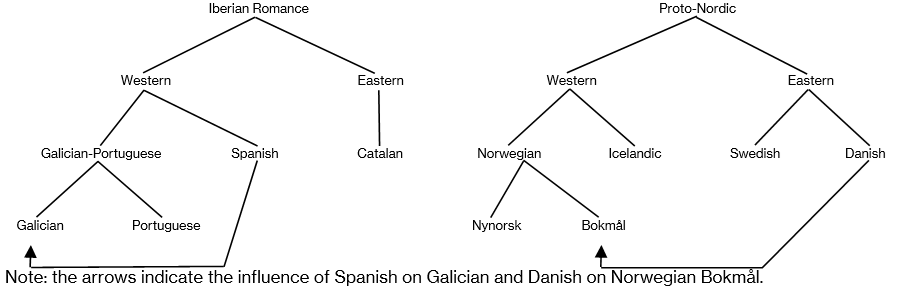
As can be seen in the diagram above, the Iberian and Scandinavian languages have absolutely parallel histories.
Romanian vs. Icelandic
Romanian and Icelandic have developed, both, in isolation, which explains their original and archaic character. For example, both have the definite article postponed to nouns, case inflection, peculiar vocabulary, etc.
While Icelandic resulted from the colonisation of Iceland by the Scandinavian Vikings, Romanian is the product of the colonisation of Dacia (now Romania, south-western Europe) by Roman legionnaires from Iberia. As a result, Romanian shares with the Iberian languages certain characteristics, especially lexical, just like Icelandic composes with the languages of Scandinavia a Germanic subfamily (see tables below).
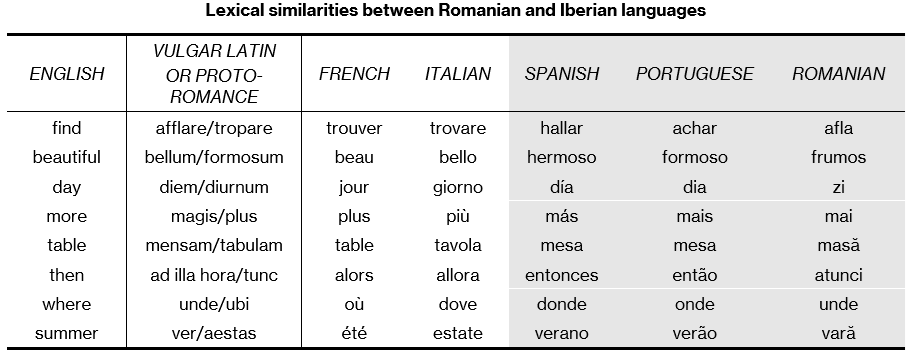
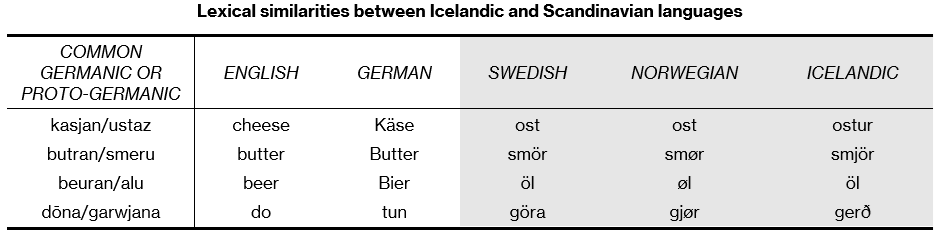
Romanian was isolated by the interposition of Turks and Slavs, who occupied the intermediate territories between Dacia and the rest of the Roman Empire, breaking the geographical and linguistic continuity of the Romance family. In turn, Icelandic found itself isolated from the beginning by the sea (Iceland is an island in the far northwest of Europe), which isolation was worsened after the end of the exchange with Scandinavia, once finished the Viking era.
Both countries, Romania and Iceland, are in extreme geographical locations and away from their families; both kept throughout history little contact with other Western nations. Therefore, both languages have different vocabulary, with terms unusual in other languages. Romanian has many words of Greek, Slavic, Turkish, Albanian origin, etc. Icelandic normally translates words of foreign origin. For example, ‘telephone’ in Icelandic is simi.
Another feature that brings near both languages is the large number of irregularities: they are two difficult languages to learn because of the profusion of inflection paradigms and exceptions to the rules. The lack of a more rigid grammatical standardisation, which could have mitigated the irregularities, reveals the archaic character of the two languages, because originally all languages presented many anomalies; later, the regularisation of forms was mainly promoted by an intellectual effort of writers, grammarians and other learned speakers.
__________
[1] The Galician-Portuguese period goes from 1170 to 1385.
[2] VENÂNCIO, Fernando. Assim nasceu uma língua: sobre as origens do português. São Paulo: Tinta-da-China Brasil, 2024.
[3] The Old Norse period goes from 1050 to 1350.
[4] For further information, see Dous padrões para a mesma língua: Noruega e Galiza, by Paulo Gamalho (written in Portuguese), available at https://pgl.gal/dous-padroes-para-a-mesma-lingua-noruega-e-galiza.