
The principle of synchronicity between the Romance and the Germanic languages is explained in detail in Supersynchronicity in languages: standard languages and dialects. This synchronicity makes each language of a family have its mirror language in the other family. And the symmetries take place in all language levels: phonetics, phonology, morphology, syntax, vocabulary, spelling, etc.
In order to demonstrate how the two families of languages mirror one another, it is sufficient to think that, by its spelling and pronunciation (and for historical reasons, of course), French is the most “Germanic” of Romance languages, just as also for historical reasons, English, thanks to its highly Latinised lexicon, is the most “Romance” of the Germanic languages. Conversely, Italian is the most Latin of the Latin languages and German, the most Germanic of the Germanic ones. As for the Iberian and Scandinavian languages, both are closer to one another than to the other languages of their families. Finally, Romanian and Icelandic are isolated languages, with little contact with the others.
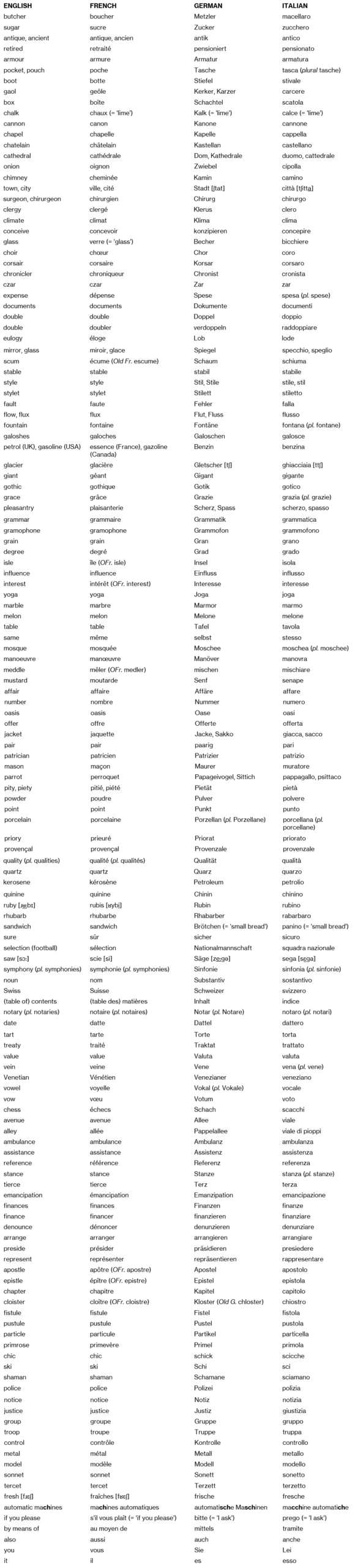
To give the reader an appetiser here, let’s stay with this short list of words and expressions of the two main languages of each family. Draw your conclusions yourself.
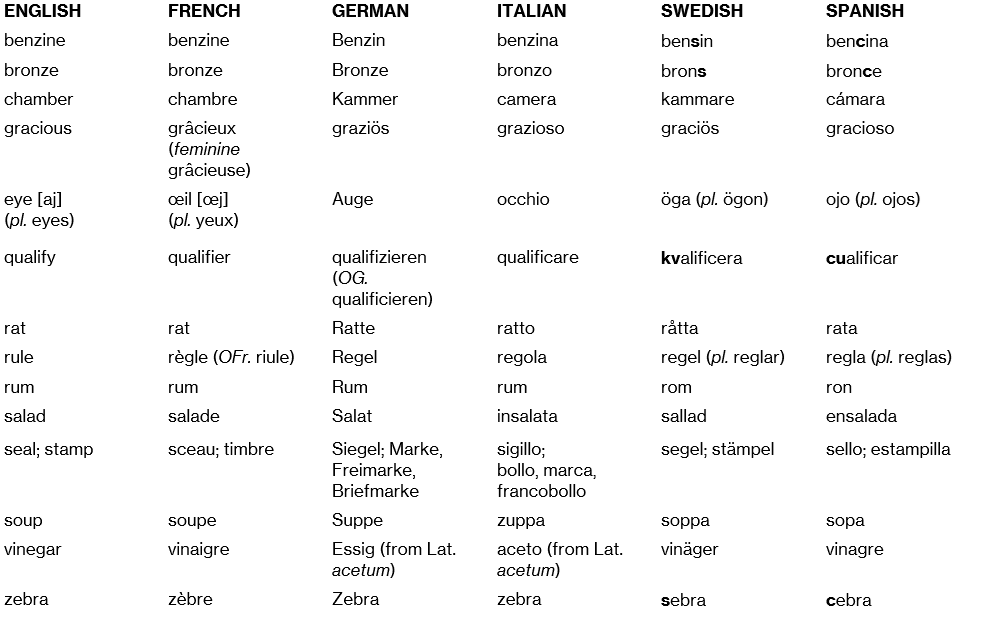
Let’s now see a list of words also of Spanish and Swedish.
With proper names symmetries are even more evident. Let’s see:
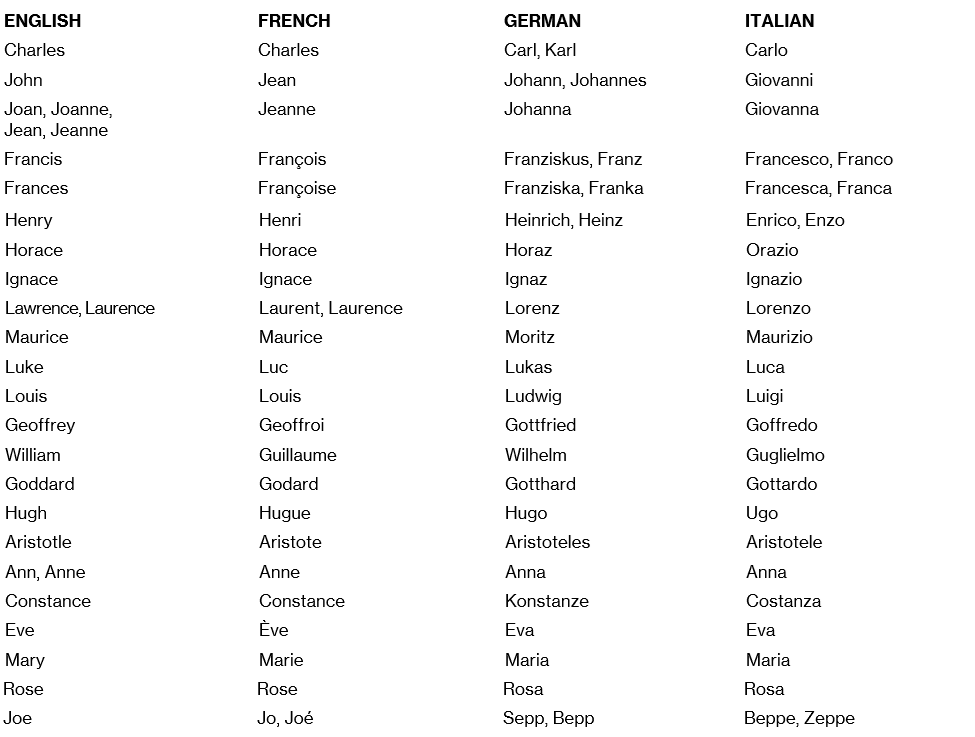
There are cases where the addition of examples of Iberian and Scandinavian languages makes the symmetries between proper names even more exciting, as in the case of Italian Andrea » German Andreas, Spanish Andrés » Swedish Anders and Portuguese André » Norwegian Andre or André. Or in the case of Portuguese Pedro, whose older form was Pero, and Danish Peder, whose older form was Per.
Let’s see finally some similarities between common words of Iberian and Scandinavian languages: Portuguese and Spanish algo » Swedish något ‘something’; Sp. algún » Sw. någon ‘some’; Port. ninguém » Nor. ingen ‘nobody’; Sp. ningún » Sw. ingen ‘none’; Port. quem » Nor. hvem ‘who’; Sp. aún » Sw. ännu ‘still’; Sp. mientras, Galician mentres » Sw. medan, Nor. mens ‘while’; Port. essas » Sw. dessa ‘these’; Port. dessas » Sw. av dessa ‘of these’; Port. deles, delas » Nor. and Danish deres, Sw. deras ‘their’; Port. minha, Gal. miña » Sw. and Neo-Norwegian mina ‘my’; Port. and Sp. luz » Sw. ljus, Nor. lys ‘light’; Sp. ángel, Catalan àngel » Sw. ängel ‘angel’; Port. bispo » Sw., Nor. and Dan. biskop ‘bishop’; Sp. ojo » Dan. øje ‘eye’; Sp. ciudad » Sw. stad ‘city’; Cat. desembre » Nor. and NNor. desember ‘December’; Port. and Cat. mestre » Nor. and Dan. mester (plural mestre); Sp. maestro » Sw. mästare or maestare ‘master’; Port. selo » Nor. sel ‘stamp’; Port. orquestras » Sw. and Nnor. orkestrar; Cat. orquestres » Nor. and Dan. orkestre ‘orchestras’; Sp., Gal. and Cat. patrulla » Sw. patrull ‘patrol’; Port., Sp. and Gal. vitaminas » NNor. vitaminar; Cat. vitamines » Sw., Nor. and Dan. vitaminer ‘vitamins’; Port., Gal. and Sp. salas » Sw., NNor. salar ‘rooms’. Finally ‘sun’ is sol in all Iberian and Scandinavian languages.
Between Romanian and Icelandic, there is, among others, the curious similarity in the words corresponding to ‘thing’: whereas in the other Romance languages we have coisa, cosa, chose, and in the Germanic thing, Ding, ting, in Romanian we have lucru and in Icelandic, hlutur.