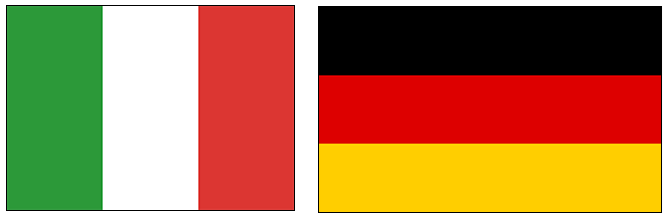
Italy and Germany have always been politically disunited countries, divided into many small kingdoms and principalities, both having only achieved political unification in the 19th century. Italy survived a short time, between the 9th and 11th centuries, as a kingdom (Regnum Italicum, or Kingdom of Italy), then fragmenting into a number of small principalities, duchies, etc. The only entity with power on the peninsula was the Papal State, or Holy Roman Apostolic See (more simply Holy See), whose sovereign was the Pope, elected by the College of Cardinals. The Holy See lasted from 756 to 1870, when Rome was taken by the Italian patriots, only regaining a territory (the tiny Vatican State) in 1929. Needless to say that the popes have always had great political power (the so-called temporal power) alongside spiritual power, since they crowned and excommunicated kings and, in some cases, had armies, waged wars and conquered territories.
Meanwhile, Germany, which as we said, had emerged as the Kingdom of Germany (Regnum Teutonicum) after the division of Charlemagne’s empire (843), soon fragmented. It was not until 962 that a political entity called the Holy Roman Empire (or simply the Holy Empire) emerged, which was never a unitary state, only a large federation of small Central European states whose princes elected the emperor by the Council of Electors. The Holy Empire had great political weight in Europe, though did not even have a fixed capital (from the 14th century on, the de facto capital became Vienna), and lasted from 962 to 1806 when, dissolved by Napoleon, was replaced by the Confederation of the Rhine (1806-1813) and the German Confederation (1815-1866). In a way, the Holy Empire survives to this day in the tiny Duchy of Liechtenstein (from 1719 — note that both this date and the date of the emergence of the Vatican State end in 9).
The Holy See and the Holy Empire always opposed, as in the so-called Investiture Controversy (1075-1122), giving rise to the phenomenon called caesaropapism. During the Middle Ages, the pope and the emperor maintained an intense dispute over the leadership of Christendom. Interestingly, although the Papal State only arose in 756 (from the so-called Patrimony of Saint Peter), the papacy has existed since the 1st century AD (the first pope would have been Saint Peter himself), although the first pontiff to bear the pope title was Liberius in 352 AD. At the same time, the Holy Empire, though founded in 962, intended to be the historical continuity of the Western Roman Empire, existing from 395 AD. In addition, the Holy Empire came to have territories in Italy (some emperors ruled from there), conflicting even more with the domains of the pope (in the same way as the Norman occupation in England violated the English sovereignty).
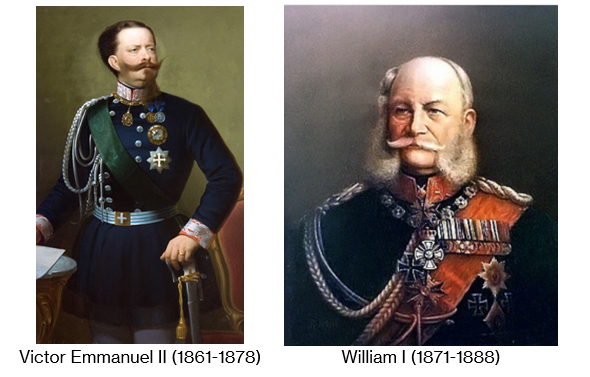
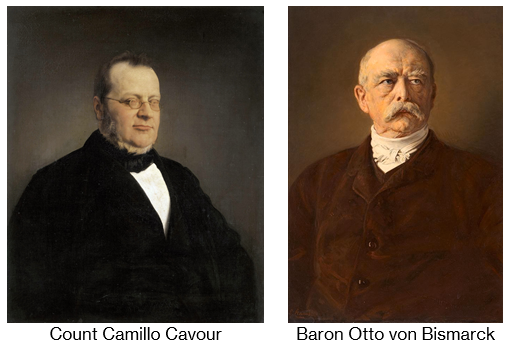
The Italian unification took place on 18 February 1861, through the work of Count Camillo Cavour, around the figure of King of Piedmont Victor Emmanuel II. The German unification was made on 18 January 1871 by Baron Otto von Bismarck in favour of King of Prussia William I. Heed the following dates: Italian unification — 18 February 1861; German unification — 18 January 1871; reign of Victor Emmanuel II — 1861-1878; reign of William I — 1871-1888. Intriguing, isn’t it? And, moreover, Rome became the capital of unified Italy in 1870, just as Berlin became the capital of unified Germany in 1871.
Two other facts that may be synchronistic: both Piedmont and Prussia begin with the letter P; Italy’s first capital, from 1861 to 1864, was Turin, while Germany’s first and only capital is Berlin.
Unified Italy had four kings: Victor Emmanuel II, Umberto I, Victor Emmanuel III and Umberto II, the latter reigning for only one month in 1946. Unified Germany had three emperors: William I, Frederick III and William II; Frederick III reigned for only three months. Note that the first and third king of Italy had the same name, as did the first and third German emperor.
Furthermore, Emperor William I began his reign as King of Prussia in the same year that Victor Emmanuel II became King of Italy (1861).
Another curiosity about the names of kings of these two countries is that, in both Piedmont and Prussia, kings with double names were common. Thus, in Piedmont we had Charles Emmanuel, Victor Amadeus, Victor Emmanuel, Charles Felix and Charles Albert. In Prussia we had John Sigismund and Frederick William.
Before the unification, Italy had a king of the Two Sicilies, Ferdinand II, nicknamed The Bomb King. Also before the unification, Germany had a Prussian king, Frederick William I, called The Soldier King.
The republic was proclaimed in Germany shortly after the First World War and in Italy shortly after the Second. In World War I, France and the United Kingdom joint Russia in the Triple Entente, and Italy and Germany joint the Austro-Hungarian Empire in the Triple Alliance. In World War II, France and the United Kingdom joint the United States and the Soviet Union in the Allies, and Italy and Germany joint Japan in the Axis.
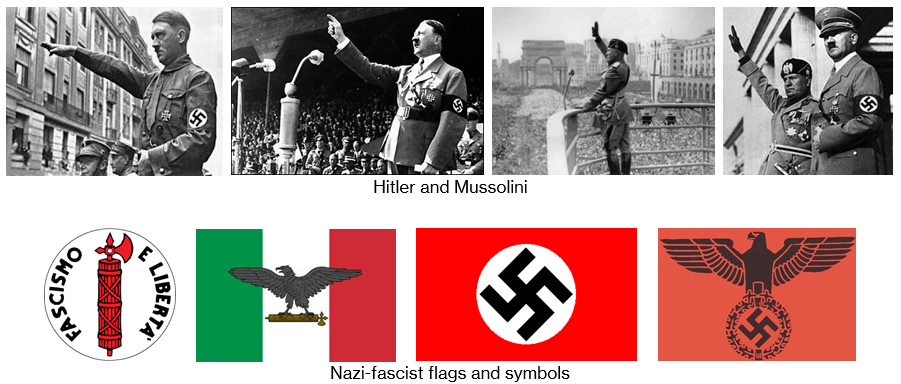
As everyone knows very well, Italy was the birthplace of Fascism, with Benito Mussolini (prime minister from 1922 to 1945), and Germany the birthplace of Nazism, with Adolf Hitler (chancellor from 1933 to 1945). Both regimes were a copy of each other, and the two countries politically joint the so-called Axis, whose tragic outcome we all know. Their symbolism and rituals were identical: the Roman salute with the raised right arm, the reference to symbols like the eagle, the fascio (bundle) and the swastika, the cult of the deified figures of the Duce and the Führer (both words meaning ‘leader, conductor’). In fact, this symbolism, which largely refers to the Roman civilisation, is an eternal reprint of the dream of building an imperium mundi, that is, bringing together the West and reviving the Roman Empire. So it was with Charlemagne, the Holy Roman Emperors, Napoleon, Hitler and Mussolini.
Another curious similarity. Both Hitler and Mussolini had famous mistresses: Hitler’s was Eva Braun and Mussolini’s, Clara Petacci. And the most curious comes now: Eva was born on 6 February of 1912 and died on 30 April, 1945; Clara was born on 28 February, 1912 and died on 28 April of 1945. Both were 33 years old and died alongside their mates.
Note that Mussolini came to power in 1922 and Hitler in 1933, years with repeated digits. Mussolini adopted the title of Duce in 1925, and Hitler entitled himself Führer in 1934. The Italian dictator’s hometown is Predappio (also known as Dovia di Predappio), and that of the German dictator is Braunau (also known as Braunau am Inn). There is even a certain sound similarity between the names Predappio and Braunau.
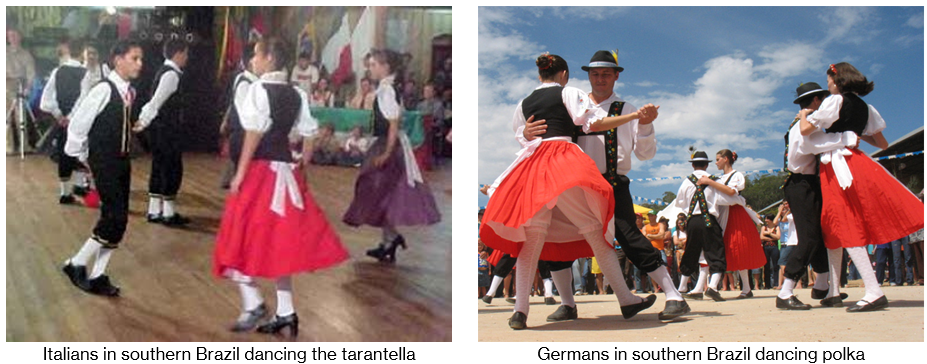
Italy and Germany were also from the 19th century the largest exporters of immigrants to the New World (see, for example, the colonies of these peoples in southern Brazil).
While Italy was the birthplace of the cultural revolution called Renaissance, Germany produced the religious revolution which was the Reformation, also called Protestant Reformation. (Both Renaissance and Reformation are names that begin with the syllable “re”.) But Germany had the second most important Renaissance, located in the region of Flanders (which at the time belonged to the Holy Empire). And to combat the Protestantism resulting from Reformation, Italy led the Counter-Reformation, or Catholic Reformation. Thus, Italy and Germany became the headquarters of the two major denominations of Christianity in the West: Catholicism and Protestantism. And the interesting thing is that all Germanic peoples, with the exception of the Austrians, converted to Protestantism, as well as all the Latins, with the exception of Romania, are Catholic.
Therefore, France has revolutionised politics with the French Revolution, Britain revolutionised the economy with the Industrial Revolution (both in the 18th century), Italy, the culture with the Renaissance, and Germany, the religion with the Reformation (both in the 16th century). Incidentally, while France was making the Commercial Revolution in the 17th century, England was making the English Revolution; and while England was making the Industrial Revolution in the 18th century, France was making the French Revolution.
It should also be noted that the revolutions in Italy and Germany (cultural and religious) were more “ideological”, whereas those in France and England were more “pragmatic” as they affected the economy and politics.
To complete, during the Modern Age (16th to 19th centuries), France took the cultural lead in literature, England in theatre, Italy in the visual arts, and Germany in music.
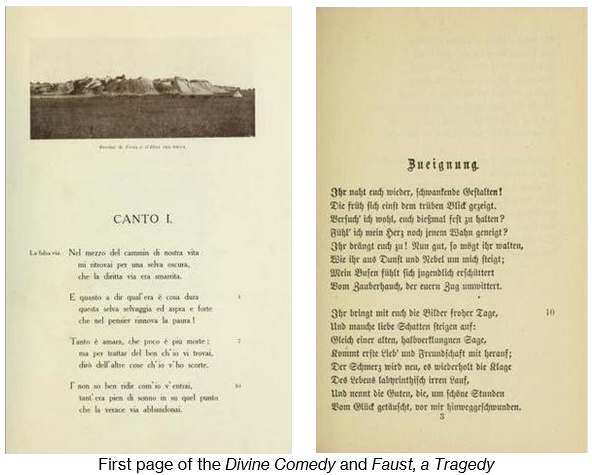
But while Italy gave us the triad of visual arts with Leonardo, Raphael and Michelangelo, and Germany offered us the trio of musical geniuses who were Bach, Mozart and Beethoven, it is no less true that the first great epic written in vulgar language was the Divine Comedy, by Dante (14th century), and the last was Faust, a Tragedy, by Goethe (19th century), both dealing about hell and the devil. Dante’s Comedy is divided into three parts and Goethe’s Tragedy into two. Note also the similarity in the terminations te in Dante and the in Goethe. These two authors are considered the greatest in their respective languages, so much so that the international institutes for the promotion of Italian and German languages and cultures are called Istituto Casa di Dante and Goethe Institut, respectively. (On the other hand, the international organisations for the promotion of the French and British languages and cultures are called Alliance Française and British Council, respectively.)
By the way, the Italian language, in which the Divine Comedy was written, was called at that time volgare ‘vulgar’, that is, the language of the people, because Italy did not yet exist as a political entity. Likewise, the name that Germans give to their own language is Deutsch, which literally means ‘popular, vulgar’. Conversely to what happened to other countries, it was the name of the German language that gave its name to the country Germany (Deutschland in German). |
Interestingly, both Raphael, who is placed chronologically between Leonardo and Michelangelo, and Mozart, who is placed between Bach and Beethoven, died young: Raphael aged 37 and Mozart aged 35.
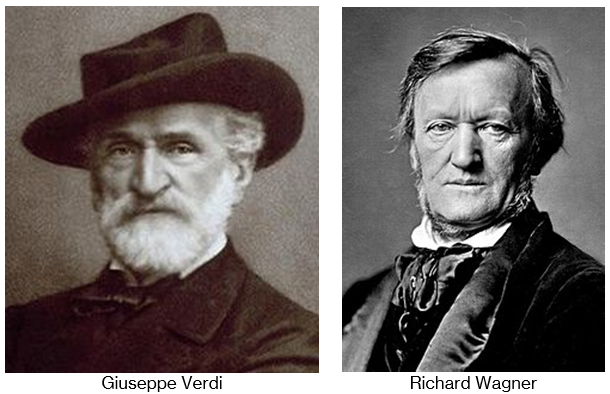
Italy and Germany also produced the two greatest opera composers of all time: Giuseppe Verdi (1813-1901) and Richard Wagner (1813-1883), both born in 1813 and with a surname beginning with the sound of “v”. And it is not by chance that the two languages most representative of operatic singing are Italian and German.
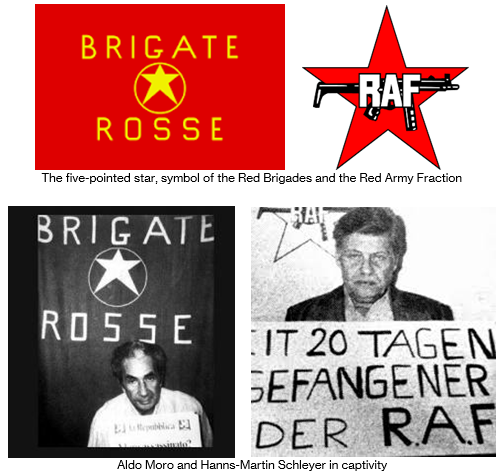
Finally, Italy and Germany were the scene, in the 1970s, of the action of guerrilla groups of communist orientation that became famous for his audacity. In Italy, there were the Autonomous (gli Autonomi) and the Red Brigades (Brigate Rosse — BR), who kidnapped and executed former Italian prime minister Aldo Moro in 1978. In Germany, there were the Autonomous (die Autonomen) and the Red Army Fraction (Rote Armee Fraktion — RAF), also known as Baader Meinhof Group, who kidnapped and executed in 1977 businessman Hanns-Martin Schleyer, in what became known as the German Autumn. Still in politics, Italy has a party called Unione dei Democratici Cristiani e Democratici di Centro (abbreviation UDC), and Germany has the party Christlich Demokratische Union Deutschlands (abbreviation CDU), both with a Christian democratic ideology.