
Historical roots of supersynchronicity in Europe
Western culture was born in Greece, but it was only when the Romans incorporated it, making it a veritably “Graeco-Roman” culture that it spread throughout Europe. Next, contributions of Jewish culture, through Christianity, were added to this culture. Therefore, the world dominated by Rome was Graeco-Roman-Judaeo-Christian.
At the same time, across the Roman borders were the barbarians, especially the Celts and Germani (that is, Germanic peoples, also called ancient Germans or early Germans), who, due to the long coexistence (and the long struggle against the Romans) also mixed their cultures so that one can speak of a single Celto-Germanic culture. Incidentally, one of the possible etymologies for the name Germanus would be ‘sibling people (to the Celts)’.
In 395 AD, the Roman Empire was divided into two: the Western Empire remained under the influence of the Church of Rome and its language, Latin, while the Eastern (or Byzantine) Empire was dominated by the Church of Constantinople and maintained a predominantly Greek culture. The Byzantine Empire and its Church profoundly influenced Eastern Europe (for example, the Cyrillic alphabet used by the Slavs is a derivation of the Greek alphabet), but had no influence in the West.
The Western Civilisation begins properly when Germanic barbarians start to invade the Western Empire, first peacefully, then by force of arms, pressed by the invasion of the Huns, from Asia, under the command of Attila (Crossing of the Rhine, 406 AD).
The Western Roman Empire is destroyed in 476, giving rise to a host of ephemeral kingdoms with an ethnically and linguistically resulting population of miscegenation of Romans and Germans. If on the one hand the Germans adopted Christianity and the Latin alphabet, the Romans adopted a series of Germanic legal, political and cultural practices (customary law, feudalism, nobility, vassalage, chivalry, courtly love, elective monarchy, etc.). In some territories, the invading Germans adopted the Romance languages spoken there, but imposing them the influence of their own languages; in other territories (in general, those who were not part of the Roman Empire), they kept their original dialects (which in specific linguistic works I call Germance by analogy with Romance).
In any case, there was an intense exchange of words and syntactic constructions between these languages, as well as social practices, so that, at the end of the day, Western Europe, although speaking languages of two families, by the way, closely related, was one civilisation, with one religion, one alphabet, the same customs, the same art, the same traditions and where Germanic peoples have Latin names such as August or Lawrence, as well as Latins have Germanic names like Henry or Bernard; where French city names end in ‑bourg (from Germanic *burgaz) and German city names end in ‑anz and ‑enz (from Latin ‑antia and ‑entia); where Italian surnames have Germanic origin and German surnames have Latin origin, and so on.
Synchronicities between France and Britain
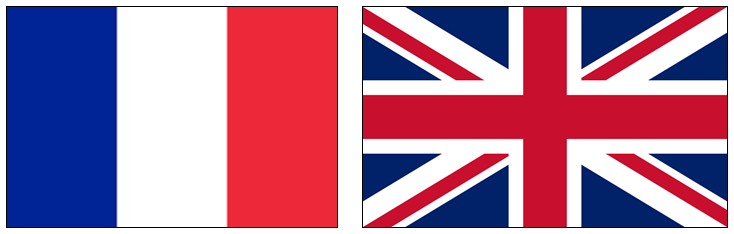
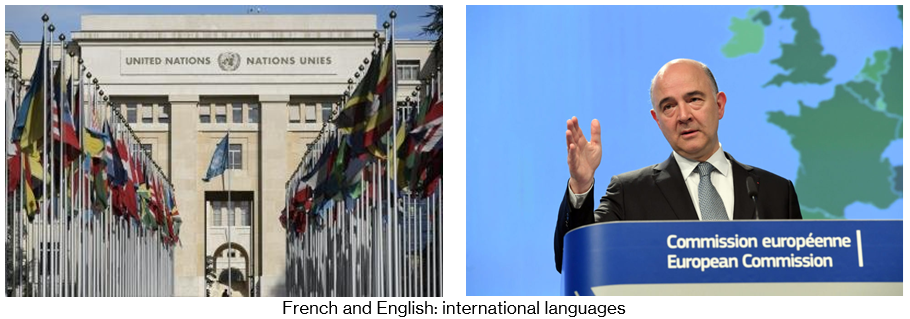
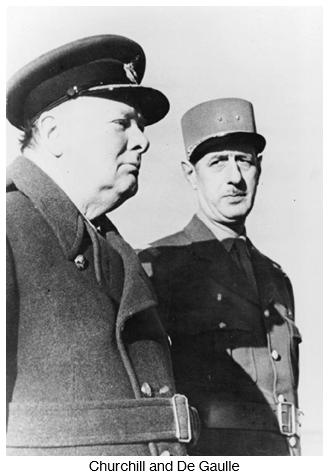
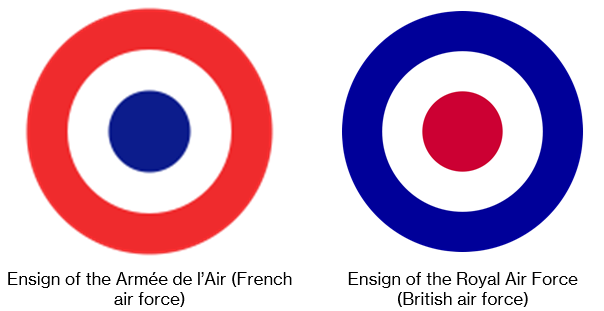
The origin of the current countries of Western Europe are the ancient medieval kingdoms: the kingdoms of the Franks and Burgundians led to France, those of the Alamanni, Bavarians and Thuringians to Germany, those of the Ostrogoths and Lombards to Italy, those of the Angles, Saxons and Jutes to England, and so on. France and Germany appear simultaneously when Charlemagne’s empire is divided among his descendants in 843: Charles the Bald holds France and Louis the Germanic holds Germany. Yet, despite this common origin (which is nonetheless a diagonal symmetry) it is with England, unified in 871 by Alfred the Great, that France will be reflected throughout its history. And not just because the French dominated England for 300 years (1066 to 1399), but many analogies between the two peoples and their languages have nothing to do with direct influence. These two countries were the two great kingdoms of the Middle Ages, the two great colonial empires of the Modern Age and the two major political and economic powers of Europe since always, to the extent that French and English have always been the two main international languages.[1] They were always two antagonistic powers (see the Hundred Years War, for example), only becoming truly allies from the two world wars, in which they were also the two great victorious nations in Western Europe (thanks to two extraordinary leaders, Charles de Gaulle and Winston Churchill). Today they are also the two nuclear powers and the two permanent members of the UN Security Council in Western Europe. In addition, Scotland Yard and Sûreté Nationale are the two most famous polices in Europe.
Resulting from their former colonial empires, France and Great Britain lead the two most important communities of former colonies, the French Community (Communauté Française) and the British Commonwealth.
Both France and England have partially mythical origins, immortalised in popular literature. The so-called Arthurian cycle makes mention of legendary King Arthur and the Knights of the Round Table (6th century), precursors of the English nation, as well as the Carolingian cycle recounts the deeds of Charlemagne and his Peers of France (8th century). But the legendary founder of France is part of the Merovingian cycle: Clovis (6th century), king of the Franks and first sovereign of what would be France.
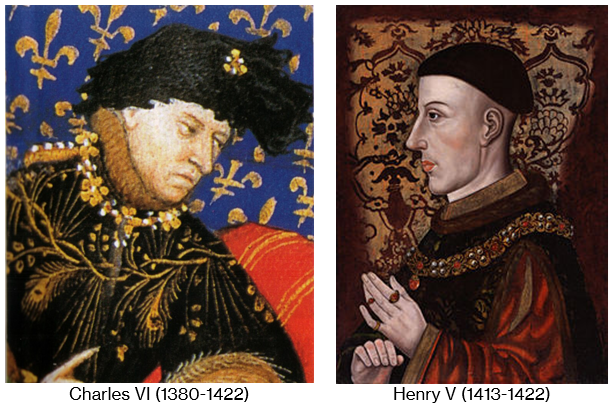
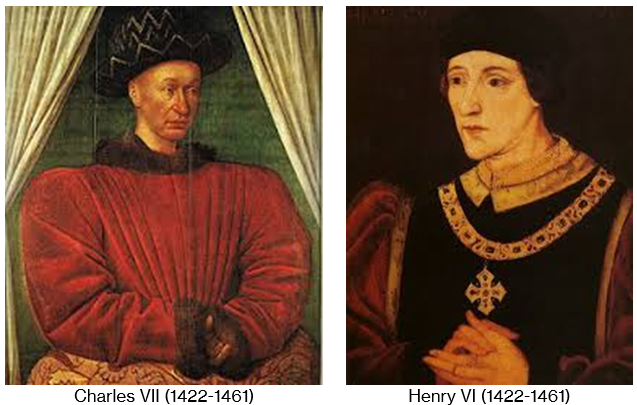
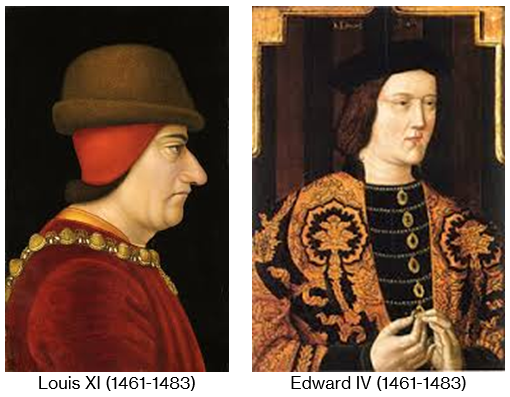
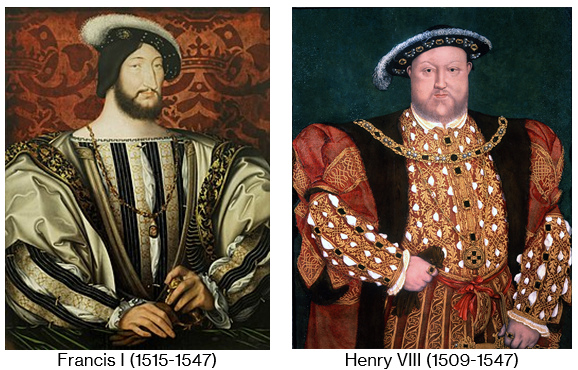
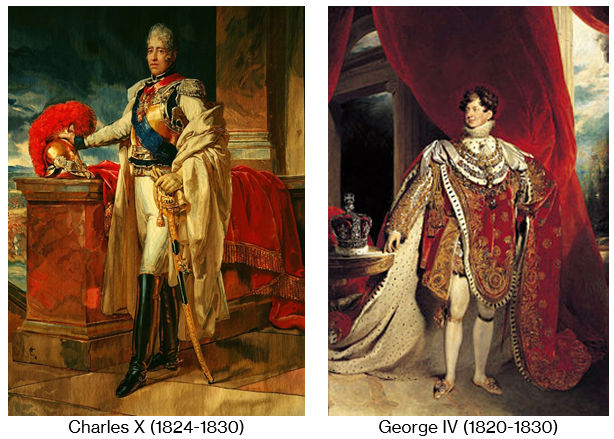
However, the historical symmetries between France and England go far beyond that and are really amazing. First, a large number of kings of France and England ascended the throne in the same year, without there being any relationship between a fact and another. For example, both Charles VII of France and Henry VI of England reigned from 1422 to 1461 (hence the predecessors of both, respectively Charles VI and Henry V, died in 1422). And his successors, respectively Louis XI and Edward IV reigned from 1461 to 1483. In addition, both Francis I (1515-1547) and Henry VIII (1509-1547) died in 1547. And both Charles X and George IV left the throne in 1830.
Another coincidence: Charles VII had his throne usurped by Henry VI between 1422 and 1429 (during this period, both monarchs disputed the French throne). Edward IV also had the throne usurped by Henry VI (what a usurper that king was!) between 1470 and 1471 (here, both disputed the English throne).
Two other curiously symmetrical facts were the wars of dynastic dispute both in England and in France. In England, between 1455 and 1485, the War of the Roses (also War of the Two Roses) was fought, which opposed the Houses of York (whose symbol was the white rose) and Lancaster (red rose). In France, there was between 1587 and 1589 (about one hundred years later) the throne dispute known as the War of the Three Henrys, which, as the name says, confronted three nobles named Henry (Henry of Guise, Henry of Navarre-Bourbon, and Henry III) in the dispute of the French throne.
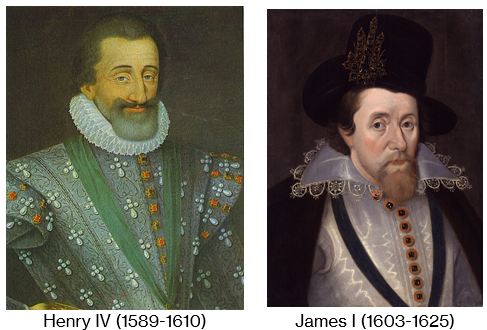
In addition, in 1589 the last French king of the Valois dynasty, Henry III, was succeeded by King of Navarre Henry IV of Bourbon, who was a Protestant, but had to convert to Catholicism to take the throne, not without facing a bloody opposition. At the same time, in 1603, English Queen Elizabeth I, the last of the Tudor dynasty, died a virgin leaving the throne to the King of Scotland James I Stuart, who was also a Protestant, but suspected of sympathising with Catholicism, also suffered bloody opposition. Until the end of the French monarchy, the kings of France also held the title of Kings of Navarre. Likewise, to this day the kings of England are also kings of Scotland, Wales and Northern Ireland.
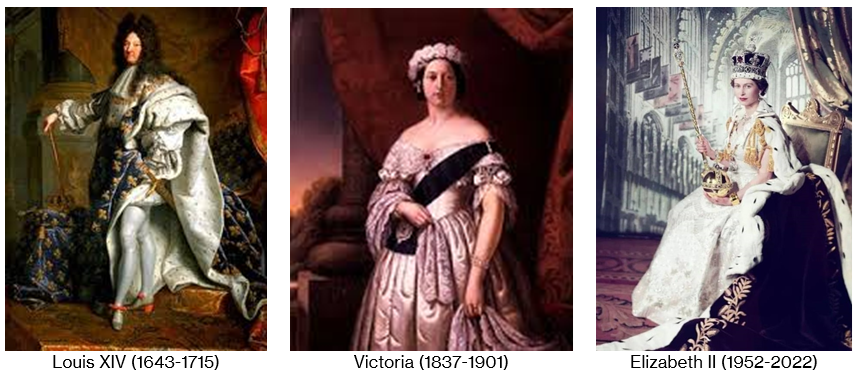
France had Louis XIV, the Sun King, whose reign, from 1643 to 1715 (72 years) was the longest in French history and marked the political, economic and cultural apogee of the country (the so-called “century of Louis XIV”). The United Kingdom had Queen Victoria, whose reign, from 1837 to 1901 (64 years), was the second longest in its history and also coincided with the political, economic and cultural heyday of Britain (the so-called “Victorian era”). Both reigns began in the second quarter of a century and ended in the first quarter of the next century.
More recently, the United Kingdom had the reign of Elizabeth II, the longest in the country’s history, which, having lasted 70 years, practically reached the time of Louis XIV’s reign. Thus, the two longest reigning kings in the world belong to the mirror nations France and Great Britain.
Another important fact: the last official residence of the kings of France, the Palace of Versailles, was built and inaugurated by Louis XIV. Likewise, Buckingham Palace became the current residence of British monarchs during Victoria’s reign.
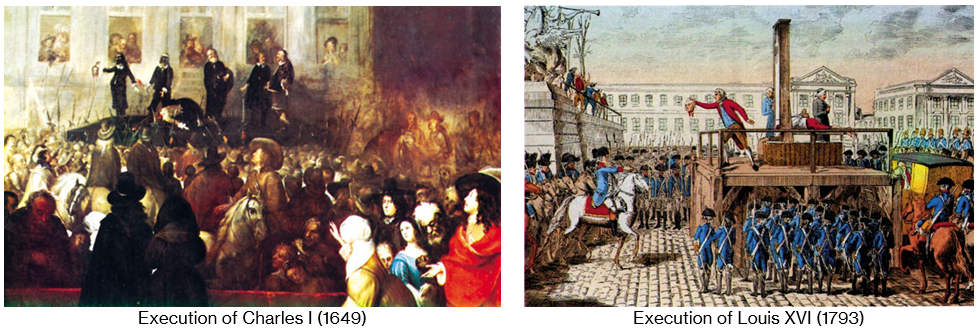
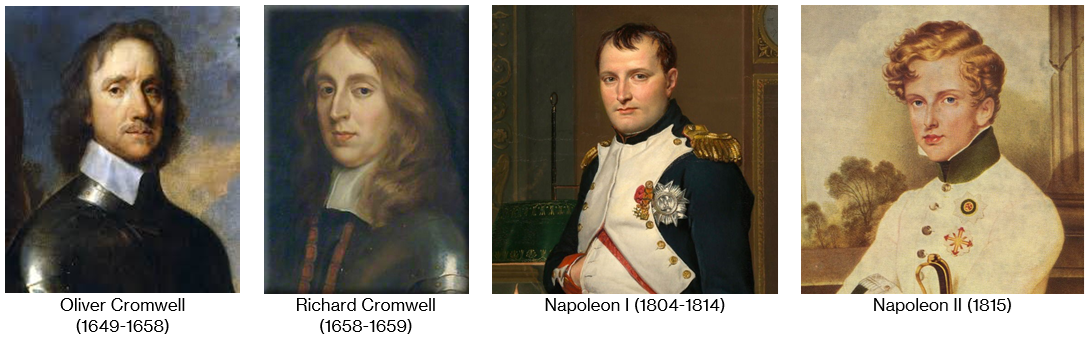
On the other hand, King Charles I of England was deposed and beheaded in 1649 by the English Revolution (1642-1949 or 1651). There was then a republican period (Commonwealth), soon transformed into the dictatorship (Protectorate) of Oliver Cromwell (1653-1658) and his son, Richard Cromwell (1658-1659), whose term lasted only eight months, between 1658 and 1659. In 1660, the monarchy was restored by King Charles II (1660-1685) and his successor and brother, James II, deposed in 1688 by the Glorious Revolution (heed the name), which ended the absolutism in England.
Similarly, in the next century, King of France Louis XVI was deposed in 1792 and beheaded the following year by the French Revolution (1789-1799), which was followed by the First Republic, soon transformed into the dictatorship (Consulate) and later the empire of Napoleon I (1804-1814) and his son, Napoleon II, whose reign lasted only two weeks, in 1815. In 1814, the monarchy was restored in Louis XVIII’s person, followed by Charles X, his brother, deposed in 1830 by the revolution known as The Three Glorious Days (heed the name), which put an end to absolutism in France. And just as the son of Cromwell succeeded his father as Lord Protector of England during eight months, Napoleon’s son, Napoleon II, succeeded him during two weeks. And Napoleon III, nephew of the first, also reigned as emperor of France. All very similar, isn’t it?
Just out of curiosity: the sums of the digits of the year of execution of Charles I (1649) and Louis XVI (1793) both equal 20. And both were executed in the month of January — Charles I on 30 January 1649, and Louis XVI on 21 January 1793. And the digits of both the 21st and 30th days add up to 3. Upon dying, Charles I was 48 years old, and Louis XVI, 38. And the period between the proclamation of the republic in England and the restoration of the monarchy (1649-1660) was 11 years, while in France this period (1792-1814) was 22 years, twice as long.
For those who like numerology, there are more interesting coincidences. The First French Republic lasted 12 years (1792-1804) and the empire of Napoleon, 10 years (1804-1814); The English republic lasted 11 years (1649-1660) and the Cromwell rule, 9 years (1649-1658). The English Revolution lasted 9 years, while the French Revolution lasted 10 years. Charles I was executed two years before the end of the English Revolution, and Louis XVI four years after the start of the French Revolution. Again, twice as long.
Just as the English Protectorate had two phases, the first with Oliver Cromwell from 1653 to 1658 and the second with Richard Cromwell from 1658 to 1659, Napoleon’s empire also had two phases: from 1804 to 1814 and other 100 days (the famous Napoleon’s Hundred Days) in 1815.
However, some historians consider that the English Revolution ended in 1649, with the execution of Charles I, and not in 1651. From this point of view, both the English and the French Revolution finished in a year ending in 9.
The French Revolution began in the 15th year of the reign of Louis XVI, while the English Revolution began in the 17th year of the reign of Charles I.
The French Revolution was a movement of liberal and libertarian inspiration, which made France the main model of liberal democracy today. In the opposite direction, the English Revolution had a Puritan character, and today the United Kingdom is the greatest example of a conservative monarchy. In any case, the constitutional regime was implemented in England in 1689 and in France in 1789.
Finally, the interval between the English Revolution and the Glorious Revolution, as well as between the French Revolution and the Three Glorious Days, was approximately 40 years.
France had 19 kings named Louis, from Louis I to Louis XVIII, plus Louis Philippe, who reigned after all of them. Meanwhile, England had 9 kings named Edward, from Edward I to Edward VIII, plus Edward the Confessor, who reigned before all of them. Louis IX of France and Edward the Confessor were both saints. Both Louis and Edward were the most frequent names of kings in these two countries. French King Louis XVII never reigned, as he died in prison following the execution of his father, Louis XVI. Meanwhile, Edward VIII reigned for just 11 months, having abdicated the throne to marry a commoner.
It is also good to remember that France was the intellectual centre of the Commercial Revolution in the 16th-17th centuries and cradle of the economic doctrine called Mercantilism (with Jean-Baptiste Colbert) and that Britain carried out the Industrial Revolution in the 18th-19th centuries, giving rise to Industrialism (with Adam Smith).
As for the Scientific Revolution of the 17th century, it was mainly the work of two philosophers, René Descartes (French) and Francis Bacon (English), and two scientists, Galileo Galilei (Italian) and Johannes Kepler (German).
Finally, both France and the United Kingdom had a period in their history known as Regency. The French Regency (Régence) occurred from 1715 to 1723, while King Louis XV was a minor. The British Regency took place between 1811 and 1820 (about one hundred years later), a period when King George III was considered mentally ill. Both historical periods are situated in the second decade of their respective centuries (18th and 19th) and both gave name to artistic styles: the Régence style influenced mainly the furniture, and the Regency style dominated the architecture. The French Regency lasted eight years and the British one, nine.
I think these examples are enough to show the parallelism between these countries.
__________
[1] A curious and symmetrical fact between these two languages is that French, for being the most prestigious international language from the 12th to the 19th century, is the language that most lent words to other languages, while English, thanks to the enormous extension of the British Empire — the greatest of all times —, was the language that most borrowed words, having a lexicon made up of items from the most diverse origins.