
In its beginnings, Brazil was already called Cabrália in honour of its discoverer, Pedro Álvares Cabral, and also New Lusitania (Lusitania is the poetic name of Portugal), just as the USA to this day adopts the poetic name of Columbia in honour of the discoverer of the Americas, Christopher Columbus. And it was also called New England, a name that remains today to designate the first colonisation nucleus of the American territory.
Brazil emerged from 15 hereditary captaincies, horizontal strips of territory distributed from north to south along the Atlantic coast, created by Portuguese colonisers and granted to nobles willing to colonise the new territory.
Analogously, the USA originated from the so-called 13 colonies, also horizontal strips of territory distributed from north to south along the Atlantic coast, founded by English colonists.
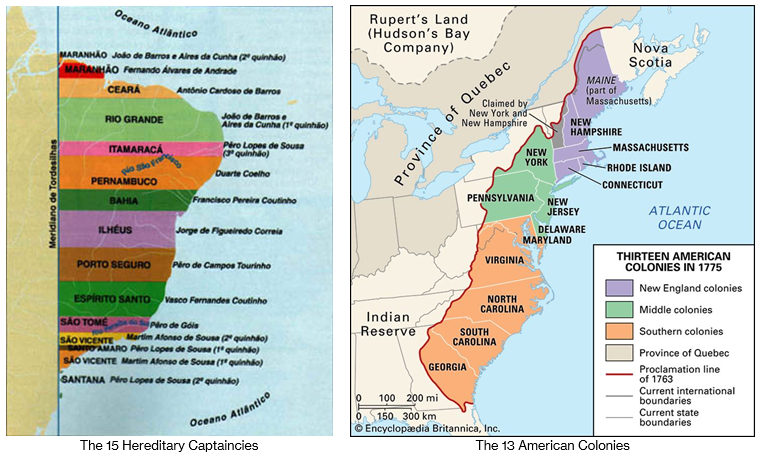
The current territories of both countries are the result of a breakthrough westwards: in Brazil, for the work of the Entradas and Bandeiras; in the USA, thanks to the Conquest of the Old West (American Frontier).
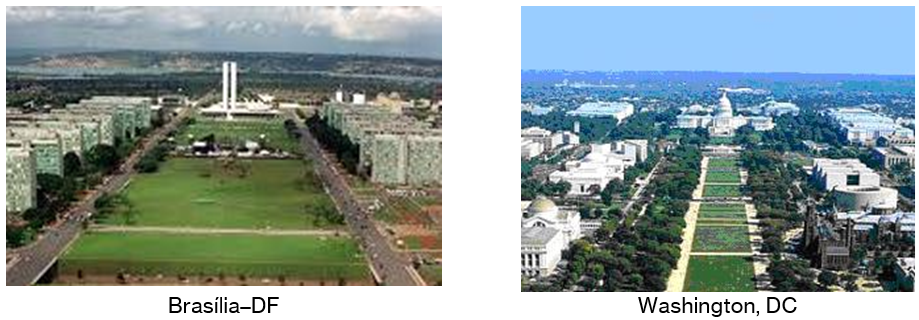
Both countries had three capitals (Brazil: Salvador, Rio de Janeiro and Brasília; USA: Philadelphia, New York and Washington). Regarding these three Brazilian and American capitals, there are also some parallels. Salvador was the first capital of Brazil, from 1549, the year of its foundation, to 1763, therefore still in the colonial period. Likewise, Philadelphia was the capital of the USA from its founding in 1682, still in the colonial period, until 1785, and again from 1790 to 1800. In 1763, the capital of Brazil was transferred to Rio de Janeiro, then the largest city in the country. In 1785, the USA capital was installed in New York, the largest American city (here we have a diagonal symmetry between Rio and New York). Finally, the American capital was definitively established in Washington, a city built for this purpose. Likewise, Brasília was built to be the new and definitive capital of Brazil.
Washington is located in the District of Columbia (DC), founded in 1790, and began to be built in 1792, being inaugurated in 1800, while the Brasília is located in the Distrito Federal ‘Federal District’ (DF), which had its cornerstone laid in 1922, and was inaugurated in 1960. Both districts were founded in years ending in 2, and both cities were inaugurated in years ending in 0. Both cities are coextensive with their respective districts.
Brazil had Presidents JK (Juscelino Kubitschek – 1956-1961), and the USA had JFK (John Fitzgerald Kennedy – 1961-1963), incidentally the most popular presidents of their respective countries — and the latter began his term in the year the former ended. But Brazil also had President FHC (Fernando Henrique Cardoso), and the USA had FDR (Franklin Delano Roosevelt). Furthermore, the patrons of independence for both Brazil (José Bonifácio) and the USA (Benjamin Franklin) were scientists.
Another interesting fact about presidents is that Roosevelt was president of the United States from 1933 to 1945, and was the last American president to be re-elected more than once. At the same time, the Brazilian presidency was held by Getúlio Vargas (GV) from 1930 to 1945 under a dictatorship. These were the politicians who remained president of their respective countries the longest, and in the same historical period. Furthermore, Vargas is, along with Kubitschek and Lula, considered one of the three most popular presidents in Brazil. Likewise, Roosevelt, Washington and Lincoln are considered the three greatest presidents of the United States.
The independence process of these two countries is quite symmetrical. In the USA, it began on 19 April, 1775, with the start of the War of Independence, or American Revolution. A year later, on 4 July, 1776, independence was proclaimed, but the revolution only ended on 3 September, 1783, with the recognition of the new state by Great Britain. In Brazil, the process began on 25 April, 1821, with the departure of King John VI to Portugal, leaving his son, Pedro, as Prince Regent. A year later, on 7 September, 1822, he proclaimed independence, but the war of liberation that began then only ended on 2 July, 1823, with the definitive expulsion of the Portuguese. Now, note the dates: 19 April, 1775 vs. 25 April, 1821; 4 July, 1776 and 3 September, 1783 vs. 7 September, 1822 and 2 July, 1823. Also note the years the conflicts ended: 1783 and 1823, both ending in 3.
Another thing: the first American president, George Washington, took office in 1789, and the first Brazilian president, Deodoro da Fonseca, exactly a century later, in 1889.
The American Civil War (1861-1865) happened about the same time as the Paraguayan War (1864-1870). But the Brazilian conflict that most resembles the American Civil War was the Farrapos War, or Farroupilha Revolution (1835-1845), which was equally separatist and slave-based. Both uprisings were defeated by the Union.
Continuing with the similarities, elections in both Brazil and the USA occur every even year. In the USA, elections are always held on the first Tuesday of November; in Brazil, when elections were held in a single round, they took place in November; today, the first shift is on the first Sunday of October, and the second shift is 28 days later, between the end of October and the beginning of November. In both countries, the inauguration of the elected presidents takes place in January of the following year, but, until the 1988 Constitution, Brazilian presidents were inaugurated on 15 March; likewise, until Franklin Roosevelt’s government, the American president’s inauguration was on 4th of March.
In the USA, elections for executive positions are indirect, made through an electoral college. In Brazil, elections were also indirect, equally through an electoral college, during the Empire and the military regime (1964-1985). In fact, in these two periods, bipartisanship prevailed; the USA is, in practice, bipartisan to this day.
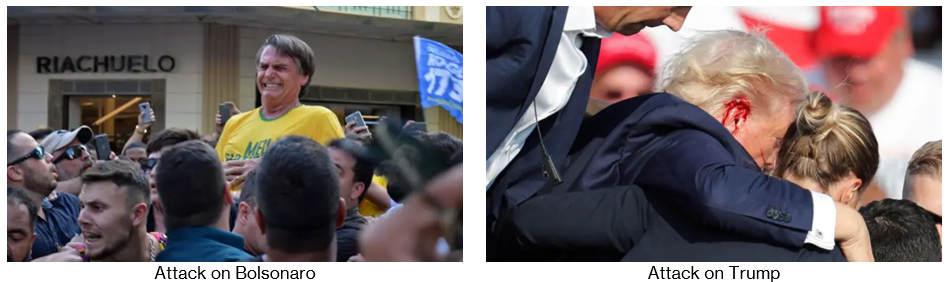
Speaking of elections, Brazil and the USA elected very charismatic presidents almost at the same time: in Brazil, Luiz Inácio Lula da Silva (elected in 2002, re-elected in 2006), the first president from the working class, and, in the USA, Barack Hussein Obama, the first black president (elected in 2008 and re-elected in 2012). Also almost at the same time, the two countries elected far-right presidents: Donald Trump in 2016 and Jair Bolsonaro in 2018. Both lost the race for re-election, the Brazilian to former president Lula himself, and the American to former Obama’s vice president, Joe Biden. Both contested the elections, accusing them of fraud. And supporters of both tried to subvert the legitimate electoral process by attempting a coup d’état. On 6 January, 2021, Trump supporters invaded and vandalised the US Congress in an attempt to prevent Biden’s election certification. On 8 January, 2023, two years and two days after the American incident, Bolsonaro supporters invaded and vandalised Brazil’s Congress, government palace and Supreme Court to try to provoke a coup d’état. And in August 2023, when visiting the State of Pará, Lula was threatened with death by a Bolsonaro supporter, who ended up arrested, just as, when visiting the State of Utah, Biden was threatened with death by a Trump supporter, who ended up killed by the police. Both Bolsonaro and Trump suffered attacks during their election campaign. Bolsonaro was stabbed on 6 September, 2018, one day before the Brazilian national date, and Trump was shot on 13 July, 2024, nine days after the American national date. Once again, history repeated itself as farce.
Both Brazil and the USA have had two presidents serve non-consecutive terms, as Getúlio Vargas ruled Brazil from 1930 to 1945 and again from 1951 to 1954, and Lula was president of Brazil from 2003 to 2010 and was elected again in 2022. On the American side, Glover Cleveland was president from 1885 to 1889 and again from 1893 to 1897, while Trump served as US president from 2017 to 2021 and was elected once again in 2024. Lula and Trump are also the only two presidents of their respective countries to be elected after having been criminally convicted by the courts. Finally, Lula, Biden and Trump are the oldest politicians in history to assume the presidency of their countries: Lula at 77 and Biden and Trump at 78.
The USA was governed by George Bush from 1989 to 1993 and by his son George W. Bush from 2001 to 2009. Jair Bolsonaro governed Brazil from 2019 to 2022, and now his son Flávio Bolsonaro is running for president, with a strong chance of winning.
One final coincidence: in 2025, the Jeffrey Epstein scandal broke in the USA, involving several political figures and with the potential to shake the American government. In that same year, the Banco Master scandal, owned by Daniel Vorcaro, broke in Brazil, also involving several prominent names in Brazilian politics and equally with the potential to shake the government, especially considering the elections at the end of 2026 in both countries.