
The traditional names of the regions where currently France, Italy, Britain and Germany are located, as well as the current names of these countries, have with each other interesting relations of symmetry, especially if we consider the Latin spelling of these names, which is the way Romans designated the provinces of their empire where later these countries settled down, which in turn had their names derived from the denomination of the barbarian peoples (i.e., pre-Roman or Germanic) that inhabited them.
Thus, the territory of modern France was called by Romans Gallia, i.e. country of the Galli (Gauls), and later, with the invasion of the Franks (Lat. Franci), came to be called Francia. The Roman Italia had this name for being inhabited by itali (calves), and has kept this name to the present. The province of Britannia was the territory of the Britanni or Britones, i.e., Bretons or Britons. With the invasion of the Angles (Angli) and Saxons, it came to be called Anglia. Finally, Germania was inhabited by the Germani, who were also known as Teutones or Teutons, whence the designation Teutonia. One of the Germanic peoples who occupied the region of Germania were the Alemanni, whose name gave rise to Alemannia designation.
Confronting Gallia, Italia, Britannia and Germania designations, which correspond to the name of the Roman provinces, we can see first of all that the four names have endings that contain the vowel a followed by a single or double consonant and termination ‑ia, characteristic of names of countries in Latin. In the names corresponding to the Latin countries (Gallia and Italia), the consonant following a is l, whereas in the corresponding names to the Germanic countries (Britannia and Germania) the consonant following a is n (in other words, Gallia rhymes with Italia and Britannia rhymes with Germania). On the other hand, in Gallia the l is double, while in Italia it is simple; at the same time, in Britannia the n is double, and simple in Germania.
Secondly, both Gallia and Germania start by G. On the other hand, Italia and Britannia both have an element IT before the stressed vowel. In Britannia and Germania, abstracting the initial G and the element IT, respectively, BR and ERM are left, both formed by R and a labial consonant (B or M). In Gallia and Italia, abstracting G and IT, nothing is left.
There are therefore horizontal, vertical and diagonal symmetry relations between these place names. We can better view these relations by writing the groups of letters that match in the same colour. We then have:
G-A-LL-IA IT-A-L-IA
BR-IT-A-NN-IA G-ERM-A-N-IA
As noted, these are the names of the Roman provinces located in these regions. With the Germanic invasions between the 4th and 6th centuries AD, these provinces came to be called after the name of the Germanic tribes that settled there, which, in most cases, gave rise to the current name of those countries. Thus the tribe of the Franks gave the name France (Francia), the tribe of the Angles named England (Anglia), Italy has retained its Latin name (Italia), while the various names by which Germany is called in different languages originate either from Latin name Germania (Italian Germania, English Germany) or the name of the tribe of the Alemanni (Portuguese Alemanha, Spanish Alemania, French Allemagne), or the ancient tribe of the Teutons, whose ancient Germanic denomination theudisk was Latinised to theodiscus (German Deutschland, Swedish, Norwegian and Danish Tyskland). Consequently, the Latin forms of all the names of peoples who gave rise to the denominations of these countries, both Roman and medieval, are as follows:
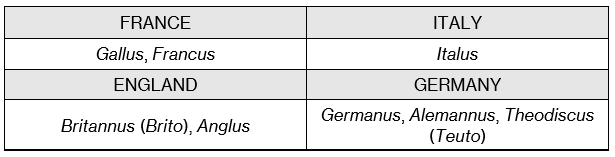
Currently, France has a unique name derived from Francus in all languages (Port. França, Sp. and It. Francia, Fr. and E. France, G. Frankreich, Sw. and Nor. Frankrike, etc.) in the same way that Italy (Port. Itália, Sp. and It. Italia, Fr. Italie, E. Italy, G., Sw. and Nor. Italien, etc.). In turn, the country that is the birthplace of the English language has three names — that somehow correspond to three slightly different geographical and political realities: England, Great Britain and United Kingdom (these three names are repeated in the other languages). Germany also has three different denominations, which vary according to the language: Port. Alemanha, Sp. Alemania, Cat. Alemanya, Fr. Allemagne, from Alemannus; E. Germany, It. and Rom. Germania, from Germanus; G. Deutschland, Du. Duitsland, Sw. and Nor. Tyskland, from Theodiscus or Teuto. (The Italian adjective for ‘German’ is tedesco, also originating from Theodiscus.)
If we compare, for instance, Gal-lus and Ang-lus, we see that, in addition to the equal ‑lus ending, the elements gal‑ and ang‑ have both letters g and a, differing only by replacing l with n. (Note that the relation between the l of Gallus and the n of Anglus is parallel to the relation between the l of Gallia and Italia and the n of Britannia and Germania.) These names gave rise respectively to adjectives Gallican and Anglican, referring to the two national churches that emerged in the Renaissance: the French church, of Catholic inspiration, and the English, of Protestant inspiration, about which I will speak in due course. Observe also the presence of element an in both Francus and Anglus. This has caused an element an to show up both in Français and Anglais, or an element en both in French and English.
On the other hand, the fr of Francus is comparable to the br of Britannus. We can then establish a diagonal relation between the Roman and medieval denominations of France and England:
GALLIA FRANCIA
BRITANNIA ANGLIA
Moreover, in the elements of composition Franco-, Anglo-, Italo- and Teuto–, to be found in compounds such as Franco-Brazilian, Anglo-American, etc., we notice the presence of anc, ang in Franco– and Anglo–, and the presence of t in Italo– and Teuto–.
Finally, there is an amazing similarity between the names Romania[1] and Germania, designations of the assembly of the Romanic and Germanic peoples, respectively. And these names survive in the names of Romania/Rumania and Germany. The same does not happen in relation to other linguistic families in Europe (there is no country called Slavia or Celtia, for example).
As Italy is the birthplace of the Roman civilisation, whose centre, the city of Rome, is located in the region of Lazio (Latium in Latin), the designations Roman, Romanic, Romance, Latin and Italian all have the same geographical origin. Consequently, we have four ethnic designations for each group: on the one hand, Germanic, Saxonic, Anglo-Saxon[2] or Teutonic; on the other hand, Romance/Romanic, Latin, Neo-Latin or Italic. (Other ethnic groups such as Greeks and Slavs have much fewer denominations.) And just as the element Latin is repeated in Neo-Latin, the element Saxonic is repeated in Anglo-Saxon.
The names of the capitals of the countries also have significant symmetries.
- Paris, Berlin and Madrid are in their original languages oxytone two-syllable words starting with a labial consonant (p, b, m), ending in dental (s, n, d) containing r in the middle and i in the last syllable.[3]
- Rome (Roma), London and Stockholm are, in the original languages, paroxytone disyllables containing vowel o in the first syllable and nasal consonant (m or n) in the last;[4]
- Lisbon (Lisboa) and Oslo have similar sounds, especially in their respective languages ([liʒboɐ], [uʃlu]);[5];
- Barcelona, Copenhagen (København), Bucharest (București) and Reykjavík are four-syllable words, in contrast to the other capitals, of short names.
In short, the correspondences are as follows:
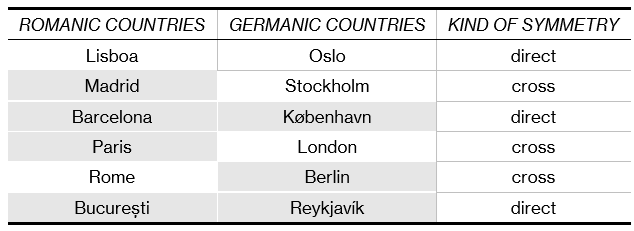
Note: A curious fact linking Lisbon and Oslo is that neither city was originally the capital of its respective country. The first capital of Portugal was Porto (also known as Oporto), and the first of Norway was Bergen. The Portuguese capital was transferred from Porto to Lisbon in 1255, and the Norwegian capital from Bergen to Oslo in 1299. Today both Porto and Bergen are the second largest cities in their countries. And both have transparent names: Oporto ‘The Harbour’ and Bergen ‘The Mountains’. Also note the dates with repeated numbers: 1255 and 1299. |
Another interesting aspect about place names and other landforms is that mirror countries have several of them with similar sounds and/or spellings.
Here are some examples:
IBERIA | SCANDINAVIA |
Arenal, Bernal, Pombal Alcázar, Trafalgar, Gibraltar Henares, Linares Talavera, Antequera, Utrera, Oliveras, Ginesteras Santander Vivero, Cisneros, Mataró Altea, Jávea Huerna, Paterna Cañas Cartagena, Valdepeñas Pamplona, Gerona, Barcelona Sonora, Zamora Alcalá, Mancala Tafalla, Valladolid Coruña, Iruña Alcoy Barbarroya, Peñarroya, Lozoya Vallès Vigo Ebro Orense Tormes Llanes Faro Seabra Yernes Melilla Astorga Vega | Arendal[6], Mondal Kalmar, Hamar Gällivare Västerås Stavanger Kragerø Luleå, Piteå, Umeå, Övertorneå Särna, Vännernå Höganäs, Tranås, Vännås Grenå Karlskrona, Landskrona Boras, Hedemora Uppsala, Sala, Motala, Pajala Uddevalla Kiruna Rolvsøy, Vanpøy, Måløy, Andøy Utøya Valle Viggsö Örebro, Nybro Odense Trones Andalsnes Fårö Arbrå Fagernes Tomelilla Ålborg Vega (no relation between the two) |
FRANCE | GREAT BRITAIN |
Étaples Épernay, Fontenay, Herblay, Orsay Coutances, Valence, Talence, Auzance Briançon Alençon, Besançon Anecy, Nancy, Berry, Giverny, Vitry, Romilly, Pontivy, Sully, Ivry Chambéry Commentry Mulhouse Troyes Redon, Verdun Belfort, Beaufort, Rochefort Chartres, Castres Lannion Perpignan Brest Gradignan Neufchâtel Auvergne Nivernais Libourne, Cherbourg Azincourt, Guyancourt, Élancourt Arles Aven Toulon Poitiers Montrouge Lagnon Nemours Avon Charente, Nantes, Nogent, Lorient Oise Anglet, Cholet Allériot, Le Creusot Cannes Cornouaille Tulle Châteaudun Strasbourg Allornes Lascaux Le Havre Le Mans | Barnstaple Colonsay, Islay, Moray, Rousay, Torbay, Torquay, Westray Penzance Brixton, Brighton Thompson Derby, Rugby, Bury, Cromarty, Dolgelly, Aberlady, Avery Banbury, Canterbury Coventry Millhouses, Stonehouse Hayes Croydon, London Bedford, Bradford, Newport, Stockport Chester, Lancaster Mullion Birmingham, Grampian Forest Cardigan Newcastle Malvern Inverness Lisburn, Sherborne, Selbourne Hamptoncourt Earls Court Leven, Devon Luton Potters Bar Montrose Paignton Kenmore Avon (in both countries) Havant Ouse (both rivers) Barnet, Watchet Ascot, Prescot, Didcot, Cheviot, Port Talbot Totnes Cornwall (same origin) Hull Cheltenham Scarborough Alburn Glasgow Newhaven Isle of Man |
ITALY | GERMANY |
Bologna Patavium (Padua) Lambrugo Laino Borgo Seborga Valborgo Breme Dresano Firenze, Cosenza, Pollenza, Dumenza Castellanza, Costanzana Ancona Trieste Gorizia Bergamo Brienza Cimbergo Spilimbergo Malalbergo Anzi, Anzio, Banzi, Branzi Berlingo, Sperlinga Soligo, Foligno Messina Lecce Lucca Siena Siracusa Monza Marzi Acerno Luserna Salerno Magherno Siderno Lerici Elba Sondrio Positano, Pozzano Gais Vernio Formia | Cologne Batavia (Passau) Hamburg Lauenburg Seeburg Waldburg Bremen Dresden Bludenz, Koblenz, Erkelenz, Kamenz Konstanz Altona Trier Görlitz Bergen, Bergheim Brenz, Bregenz Schömberg Spangenberg Mahlberg Danzig (currently belonging to Poland) Berlin, Gerlingen Solingen Meissen Celle Lübeck Jena, Siegen Leverkusen Mainz Merzig Achern Luzern (Switzerland) Sollern (Austria) Möckern Simmern Ellrich Elbe Sontra Potsdam Geisa Werne Worms |
There are also interesting similarities between the names of some languages that are mirrors to each other. In Portuguese, the designations português and norueguês (Portuguese and Norwegian) are almost identical (see, in capital letters, the coincident letters: pORtUGUÊS vs. nORUeGUÊS). In French, the words français and anglais have in common the sequences of letters an and ais. In Swedish, the Spanish language is called spanska and the Swedish, svenska. In Icelandic, ‘Romanian’ is rúmenska and ‘Icelandic’ is íslenska.
__________
[1] Not to be confused with the country Romania; see the entry Romania in the Glossary.
[2] Although the term Anglo-Saxon refers exclusively to Great Britain, it is common in Romance languages for it to be used synonymously with Germanic.
[3] In this case, we have a cross-symmetry. (For cross-symmetry, cfr. the Glossary).
[4] Idem to the previous footnote.
[5] For the explanation of the phonetic symbols, see the Phonetic Alphabet.
[6] In Norwegian, Arendal means ‘Aren Valley’. And in Spain there is the city of Val d’Aran, that means ‘Aran Valley’.