
Synchronicities Between Iberia And Scandinavia
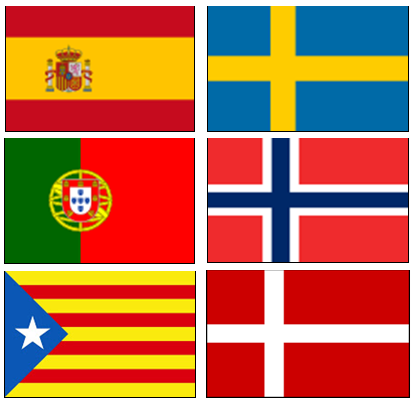
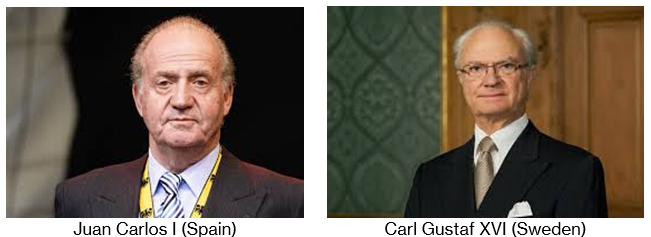
In addition to the aforementioned fact that the two peninsulas have a great geographic similarity, projecting west to the Atlantic and being occupied by two states, one of which is confined to the western edge of the peninsula, Iberia and Scandinavia have much in common in terms of history and ethnic composition.
Both peninsulas are home to four basic populations (five if we consider that one of them is divided into two subgroups). Iberia is formed by Spaniards (also called Castilians), Catalans, Portuguese, Galicians and Basques (Euskara in their own language), the latter of non-Indo-European origin and already present in the Iberian Peninsula long before the arrival of the Romans. Galicians and Portuguese are almost the same people, so that Galician (or Galician-Portuguese) is nothing but a Portuguese dialect strongly influenced by Spanish. In fact, Galicians, Catalans and Basques are bilingual, as they also speak Spanish.
Similarly, Scandinavia consists of Swedes, Danes, Norwegians, Neo-Norwegians and Lapps (Sami in their native language), an equally non-Indo-European people who was already in the area when the first Germanic peoples arrived there. Norwegians and Neo-Norwegians are one people (legally speaking, they are all Norwegians): what happens is that while 90% of the Norwegian population speaks only the so-called Dano-Norwegian, or Bokmål, heavily influenced by Danish, one tenth of the population is bilingual, also speaking Neo-Norwegian or Nynorsk, a more legitimate and conservative variety. Evidently, the Lapps are also bilingual, as they can speak Swedish or Norwegian.
The five peoples who form each of the peninsulas organised politically in different ways throughout history.
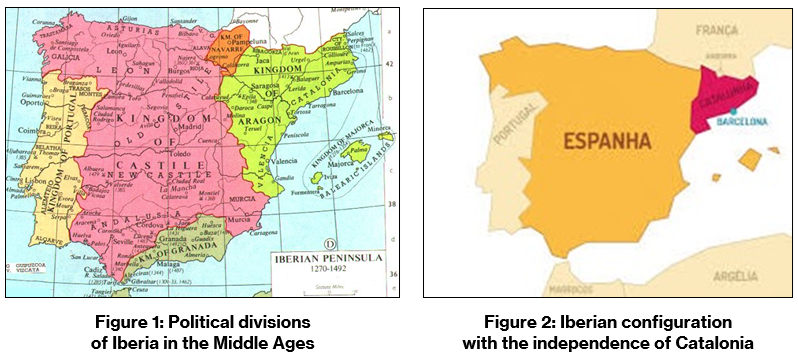
Political divisions of the Iberian Peninsula
In the Iberian case, the Kingdom of Portugal was formed in 1143. The other two great kingdoms, Castile (core of Spain) and Aragon (which included Catalonia), joint in 1492, thanks to the marriage of their monarchs, Isabella and Ferdinand. The grandson of the couple, Charles of Ghent, became in 1516 the first king of Spain (or the Spains, as it was called at the time) under the name of Charles I (in 1519, he would also become Charles V of the Holy Empire). Since then, the Kingdom of Spain brings together the Castilian, Catalan, Galician and Basque ethnicities, while the Portuguese ethnic group has its own territory.
Between 1580 and 1640, there was the Iberian Union, in which Portugal and Spain formed a single kingdom under the aegis of the Spanish sovereign. During this period, the entire peninsula was a single state. In 1640, Portugal broke up the union, turning to be an independent kingdom.
Today, Iberia is composed of two sovereign states, Portugal and Spain, but the latter is actually a federation of autonomous and separatist regions: Galicia, which, although belonging to Spain, is an ethnic continuation of Portugal; Catalonia, which lost its independence in the 15th century, may soon regain it; and the Basque Country has struggled for years, even through terrorism, for its independence.
If Catalonia does indeed become independent, the new configuration of the Iberian Peninsula will be as shown in Figure 2.
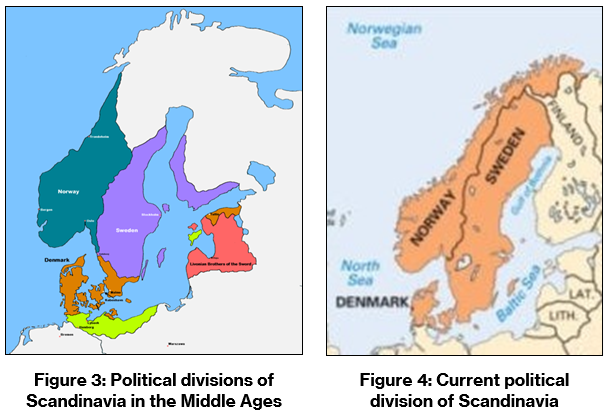
Political divisions of Scandinavia
The Scandinavian peninsula is also the result of the union of several kingdoms. Until the 14th century, there were the kingdoms of Sweden, Norway and Denmark (this, if we consider that, although geographically separated by the sea, is part of the historical group called Scandinavia). Norway lost its independence to Denmark in 1380 (compare this date to 1580, date of Portugal’s loss of independence to Spain); from then, Scandinavia consisted of two states: Sweden and Denmark-Norway.
From 1397 to 1523, the Kalmar Union took place between Denmark-Norway and Sweden, during which Scandinavia housed a single state. Sweden broke the union in 1523 and therefore the peninsula returned to have two states, Sweden and the United Kingdom of Denmark and Norway. In 1814, Norway passed from the Danish rule to the Swedish and only in 1905 became independent.
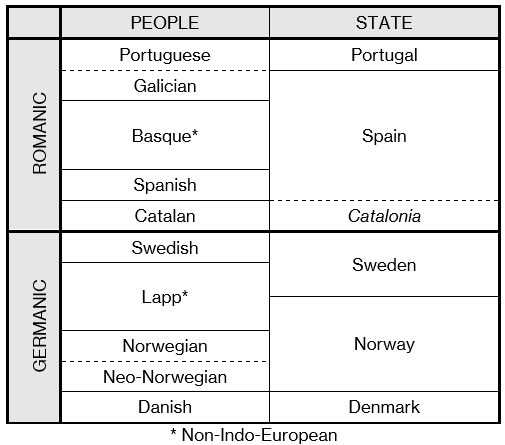
So in both cases we had three realms that, around the same time (14th-15th centuries), became two. For a time, there was a union of the two kingdoms (Iberian Union and Kalmar Union) in a single, then again split into two kingdoms. The only difference is that Norway, with its two ethnicities (Dano-Norwegians and Neo-Norwegians), gained independence nearly a century ago. But if, as we said, and political events seem to point, Catalonia becomes independent of Spain, the symmetry between the two peninsulas will again be perfect, with the exception that Galicia will continue to be part of Spain, not of Portugal, as it would be more logical.
The correspondence between peoples and states would be as follows (non-independent states are in italics):
As previously mentioned, both the Iberians and the Scandinavians became famous as navigators. And while France, Italy, Germany and Britain are on the same level of development, Scandinavia has always been considered the most developed region of Europe (and the world); conversely (and this is also a kind of symmetry), Iberia once was the most backward region. In any case, Iberia and Scandinavia have always played peripheral political and cultural role in relation to the central nations (France, Britain, Italy and Germany).
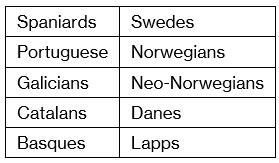
In summary, we have, in addition to geographical similarity and maritime tradition, two sets of peoples between which one can establish the following relation:
Synchronicities between Romania and Iceland
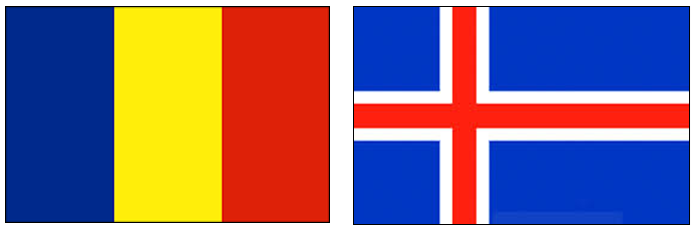
The region of Dacia, where Romania is located today, was late colonised by Romans coming mainly from the Iberian Peninsula, which partly explains the similarity of the Romanian vocabulary with that of the Iberian languages. Dacia remained Roman for about 150 years, but even so, traces of Latinity remained over time, so that, even though the region was invaded by Slavs, Hungarians, Turks, etc., and stayed for centuries separated from the rest of the Roman provinces, it maintained the Latin language and the name Romania, which refers to Rome.
Nevertheless, the geographical isolation from Western Europe made Romania only become independent from the Ottoman Empire in 1877, constituting a monarchy that lasted until 1947. Since then, it became a socialist republic, only abandoning this regime in 1989.
Linguistically, Romanian is the most different among the Romance languages and also the most complex, with a number of irregularities due to its archaic and conservative aspect. Much of its vocabulary comes from Slavic languages, which makes it very difficult to understand by the other Romance languages.
In turn, Iceland is a volcanic island colonised in the 8th century by the Vikings from Scandinavia, which explains the linguistic familiarity between Icelandic and the Scandinavian languages. The commercial and cultural exchanges between the continental Scandinavians and the Icelanders was always precarious, which made the island develop in isolation for centuries.
Iceland remained a Danish possession until 1918, when it became a monarchy (whose king, however, was Danish). In 1944, the republic was proclaimed, three years before the proclamation of the republic in Romania.
In other words, both countries gained independence just over a century ago and had short-lived monarchies.
The Icelandic language is the most distant and complex among the Germanic ones, full of irregularities and with a very archaic character. His vocabulary is entirely the result of calques (translations) of foreign words. For this reason, the language is hardly intelligible to other Germanic peoples.
As a final curiosity, most Romanian surnames end in ‑escu, while all Icelandic male surnames end in ‑sson and all female in ‑dóttir. All these endings mean ‘son/daughter’.