
Geographical distribution of standard languages
A standard language is considered as national when it is the only official in the entire nation territory. The existence of small communities speaking other languages within that territory does not take, by itself, from the dominant language the status of national language. For example, Portuguese is the national language in Brazil, as the other languages (Italian, German, native languages) are spoken in specific locations and have no official status.
When more than one language has national status (i.e. we have multilingualism or polyglossia), we say that each of them is a co-national language. There are also regional languages, that enjoy official status within a particular province or autonomous region.
Two examples of multilingual states are Belgium and Switzerland. In the first, French and Dutch are on an equal footing, as co-national: none of the two populations (Walloon and Flemish) has the obligation to speak the language of the other (although this often happens), and formal communication is made in any of the two languages — or both. In the second, German, French, Italian and Romansh coexist as official languages, although the latter is spoken by a very small portion of the population, concentrated in one canton (Grisons).
If we consider only independent nations and officially recognised languages (i.e. excluding dialects and non-official languages), we have the following situation:
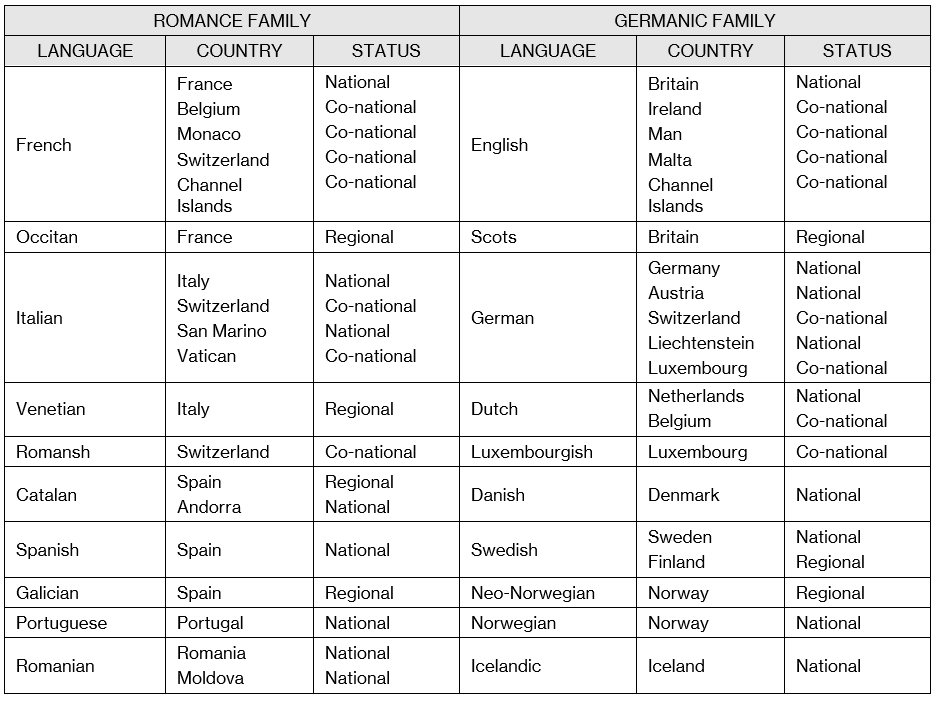
First of all, the only cases of language-state two-way relationship (where the language is at the same time national and spoken in a single state) are Portuguese in Portugal, Danish in Denmark and Icelandic in Iceland.
Among the Latin nations, Spain, France and Italy are multilingual. Spain has Spanish as the national language and Catalan, Galician and Basque (this, of non-Indo-European origin) as regional languages, in addition to various other dialects; France has French (national), Occitan and Breton, the latter of Celtic origin (regional); Italy has Italian as the national language and, since 2007, Venetian at regional level.
On the German side, Norway and Britain are multilingual. In the Norwegian case, Bokmål is the national language and Nynorsk is regional (western provinces); in Britain, English is national, and Scots and Welsh are regional. In the far north of Scandinavia Lapp is also spoken, a native, also non-Indo-European language. By the way, Basque and Lapp are languages of very remote origin, because their populations were already where they currently are long before the arrival of the Indo-Europeans (Romans and Germans). The Basque population is distributed between Spain and France, while the Lapps are divided between Sweden, Norway, Finland and Russia. Another curious fact is that according to genetic studies, there would be a remote kinship between the Lapps and the Basques.[1]
In this regard, there is also a symmetry between the Iberian and the Scandinavian peninsulas: in Iberia five languages are spoken — four Romance (Portuguese, Galician, Spanish and Catalan) and one of native origin (Basque); in Scandinavia there are also five languages, four Germanic (Norwegian, Neo-Norwegian, Swedish and Danish) and one indigenous (Lapp).
French, national in France, is co-national in five other countries: Belgium (with Dutch), Luxembourg (with German, Dutch and Luxembourgish), Switzerland (with German, Italian and Romansh), Monaco (with Monegasque) and Channel Islands (Guernsey and Jersey), alongside English. English is national in Britain and co-national with Gaelic in Ireland, with Maltese in Malta, with Manx in Man, in addition to the aforementioned Channel Islands.
Italian is national in Italy and San Marino and co-national in Switzerland and the Vatican (with Latin); German is national in Germany, Austria and Liechtenstein, and co-national in Switzerland and Luxembourg (with French, Dutch and Luxembourgish).
Romansh and Luxembourgish are both co-national in their native countries and both had their recognition as official languages in a relatively recent past (Romansh was recognised in 1938 and Luxembourgish in 1984). Symmetrically, both languages, although they are the only native in their respective countries, are also minority languages, with the lowest number of speakers (both in Switzerland and Luxembourg, German and French are the main languages).
An interesting fact is that in Switzerland three Romance languages (French, Italian and Romansh) and one Germanic language (German) are spoken, whereas in Luxembourg three Germanic languages (German, Dutch and Luxembourgish) and one Romance language (French) are spoken.
German, on the Germanic side, and Romanian, on the Latin, are the only national languages of two European macrostates (macrostate is a large state, i.e., the opposite of a microstate[2]): Germany and Austria, in the German case; Romania and Moldova in relation to Romanian.
The Romance family has four regional languages: Galician, Catalan, Occitan and Venetian. The Germanic has three: Scots, Neo-Norwegian and Swedish (national in Sweden and regional in Finland).
In summary, there are three cases of multilingual nations in the Romance family and two in the Germanic. Disregarding the presence in microstates, there are three Latin transnational languages (French in France, Belgium and Switzerland, Italian in Italy and Switzerland, Romanian in Romania and Moldova) and four Germanic (English in Britain and Ireland; German in Germany, Austria and Switzerland; Dutch in the Netherlands and Belgium, and Swedish in Sweden and Finland). There are biunivocal relations between state and language, one in the Latin scope and two in the Germanic.
If match each language with the independent macrostate(s) where it has national language status, we will see that on the Romance side there are ten languages and six states, while on the Germanic side there are ten languages and eight states.
Considering only Romanic and Germanic macrostates with at least one national language, the relationship that is established is as follows (in the following table, languages in italics are regional, and regions in italics, separated by dashed lines, are autonomous but not independent):
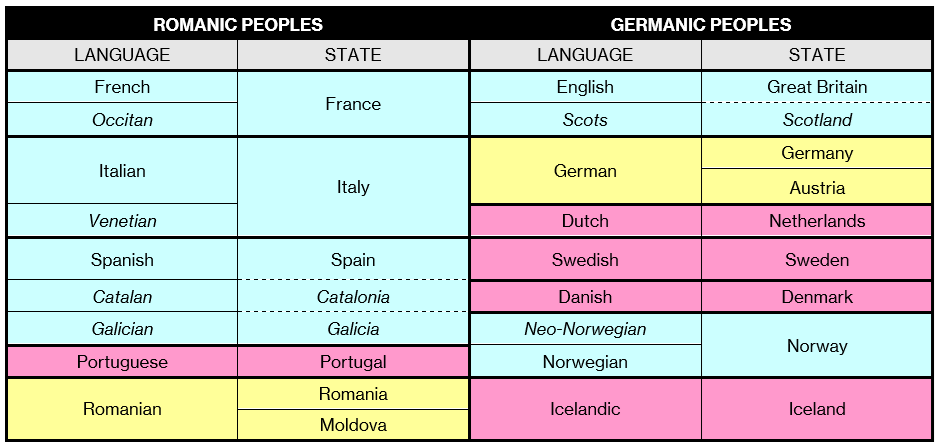
As we have seen, there are three Romanic and two Germanic states with more than one language (blue cells); every family has a national language in more than two states (yellow cells). The biunivocal relations state-language are in pink cells.
We also have the following situations: while Scotland is an autonomous territory of Britain, Occitania has no political autonomy. On the other hand, Galicia and Catalonia are autonomous regions of Spain, while Neo-Norwegian speech zone has no name or autonomy.
Systematising these relationships, we can say that the ten Romance languages are distributed in Europe in six independent states (Portugal, Spain, France, Italy, Romania and Moldova), two autonomous regions (Galicia and Catalonia) and two non-autonomous regions (Occitania and Venetia), while the ten Germanic languages are divided into eight independent states (Great Britain, Netherlands, Germany, Austria, Denmark, Sweden, Norway and Iceland), one autonomous region (Scotland) and one non-autonomous region (western provinces of Norway). That is, although in different proportions, independent states and autonomous regions or not total ten regions in both families.
A case that deserves our particular consideration is the symmetrical relationship between Iberia and Scandinavia. Both peninsulas shelter each four Indo-European languages (Portuguese, Galician, Spanish and Catalan, in the Iberian case, Norwegian, Neo-Norwegian, Swedish and Danish, in the Scandinavian) and one non-Indo-European (Basque in Iberia and Lapp in Scandinavia). Today, Iberia is divided into two states, Portugal and Spain, and this is home to three of the four Romance languages of the peninsula. However, the strong Catalan separatist movement makes us suspect that a future independent Catalonia is not unlikely. In this scenario, we would have three states, of which one (the remaining Spain) would house two languages (Spanish and Galician). But for centuries Norway remained attached to the Kingdom of Denmark and then to Sweden, having only gained independence in 1905. Thus, for several centuries Scandinavia was also divided into two states, one of which — Denmark — housed three languages (Danish, Norwegian and Neo-Norwegian). We must also remember that Galician is technically a dialect of Portuguese heavily influenced by Spanish, as well as Norwegian Bokmål was strongly influenced by Danish. In this case, and contrary to what happens in Iberia, what would be the legitimate Norwegian — Nynorsk — is considered a dialect of Bokmål. However, according to the Portuguese linguist Fernando Venâncio, in his book Assim nasceu uma língua (Thus a Language Was Born), Portuguese descends from Galician, or rather, it is a dialectal variation of it that became an independent language. Thus, in the same way that Norwegian Bokmål, the most important language in Norway, comes from Nynorsk, Portuguese, a more prominent language than Galician, comes from it.
The traditional Portuguese spelling, which used ph, th and y, was abolished in 1911, one year after the proclamation of the republic; the traditional Norwegian spelling, of strong Danish influence, was abolished in 1907, two years after the proclamation of independence.
Thus, although neither the languages nor the states correspond point by point, the linguistic and political situation on both peninsulas is astonishingly analogous.
Languages and varieties
Languages spoken in more than one country often have domestic varieties, or particular ways of using the language in each country. These varieties stand out especially in the vocabulary and pronunciation, though in some cases there are also grammatical differences. Among the Romance languages that have domestic varieties, we have Portuguese (European, Brazilian and African), Spanish (Iberian and Latin American), French (European, American, African and Asian), Italian (Italy and Switzerland) and Romanian (Daco-Romanian in Romania and Moldovan in Moldova). Galician, as we have seen, has two orthographic varieties: traditional, Spanish-inspired, and restored or reintegrationist, following the Portuguese spelling. Both are accepted officially, but the first is the most widespread. Occitan also admits two spellings: Mistralian, French-influenced, and classical, with its own characteristics.
Among the Germanic languages, Neo-Norwegian, the mirror language of Galician, also has two varieties (Nynorsk and Høgnorsk). Dutch is divided into Hollandic (in the Netherlands) and Flemish (in Belgium) and also has overseas varieties in America and Africa. German has the German and Austrian-Swiss varieties. English is, along with French, the language with the largest presence in all continents. It has the European varieties (British and Irish), American (USA, Canada, Jamaica, Guyana, etc.), African, Asian, also including several countries in Oceania, among them two very important: Australia and New Zealand. Finally, Swedish has the Swedish and Finnish varieties.
Specifically in terms of transcontinental languages, that is, those spoken also outside Europe, we have on the Romance side, Portuguese, Spanish and French; on the Germanic, English, Dutch and Danish. Therefore, three languages of each family. It is exactly these six languages that are present in America: Portuguese in Brazil, French in Canada, West Indies, French Guiana and Haiti, Dutch in Suriname and the Antilles, Danish in Greenland, English in USA, Canada, Jamaica, Guyana and West Indies, and Spanish in the rest of the Americas.
Spanish and English are hegemonic in the continent. However, while English is spoken in two very important countries (USA and Canada), Spanish is sprayed in a number of peripheral republics, of which only Mexico and Argentina have some prominence. In contrast, Portuguese and Danish are spoken, each in a single country, with the difference that Brazil is the most important nation in Latin America, while Greenland, a huge ice island, is the least important of all the continent. In intermediate positions are located French and Dutch.
In any case, on both the Latin side and the Germanic, the colonisation of America was made by three nations, one of which was a great economic, political and cultural power (France and England, respectively) and two were peripheral states, economically powerful at that time but less influential in other aspects (Portugal, Spain, the Netherlands, Denmark). What happened was that in the Germanic context, the most developed power (England) established in the New World the most important colonies (USA and Canada), while the Netherlands and Denmark kept only secondary possessions, like Suriname, Netherlands Antilles and Greenland. Conversely, in the sphere of the Latin peoples, France, the most developed European Romanic state, remains with less important colonies (Haiti, French Guiana, Martinique and only a small portion of Canada) while most of Latin America is colonised by Portugal and Spain. This is perhaps another factor to explain why Anglo-Saxon America is more developed than Latin America.
Another interesting aspect is that, in the Middle Ages, European maritime navigation turned to the East and, in the Renaissance, to the West — the New World. The Latin states that devoted themselves to navigation and, possibly, the colonisation of other territories were Portugal, Spain (initially as Castile and Aragon), France and the so-called Maritime Republics (Genoa and Venice, mainly). On the Germanic side, we had England (Great Britain), Netherlands (United Provinces), Denmark (which then included Norway), Sweden and the city-states of Hansa, or Hanseatic League (especially Hamburg and Lübeck).
The states that dominated medieval seas were, on the Latin side, the republics of Venice and Genoa, and, on the Germanic side, Sweden and the Hansa. Venice reached the Near East and monopolised the spice trade with the Ottoman Empire. Meanwhile, the Scandinavians colonised Finland and northern Russia as far as Novgorod and Kiev and reached the Near East.
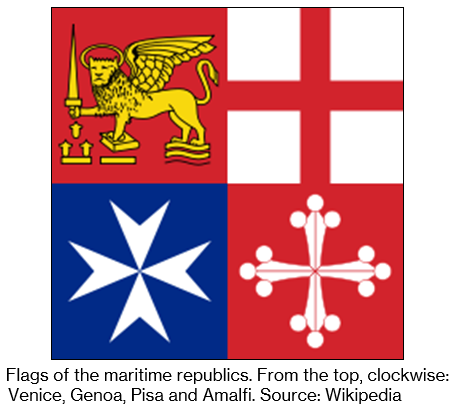
In turn, the great maritime nations of the Renaissance were Portugal, Spain and France (Latin), and England, the Netherlands and Denmark (Germanic). While the Hanseatic League and Sweden set out to the East, Portugal, Spain and France headed to the West; while Genoa and Venice sought the East, England, the Netherlands and Denmark sailed to the West. France and England conquered the Americas, Africa and Asia. Portugal, Spain and the Netherlands also advanced to Africa and Asia. Catalonia and Norway indirectly participated in these conquests, since at the time they were under the respective rule of Spain and Denmark.
Note that, from the point of view of supersynchronicity, Venice, which was one of the Maritime Republics (the others were Genoa, Pisa and Amalfi, mainly), corresponds to the Netherlands, while Sweden, who was part of the Hanseatic League, corresponds to Spain.
We would then have the following table:
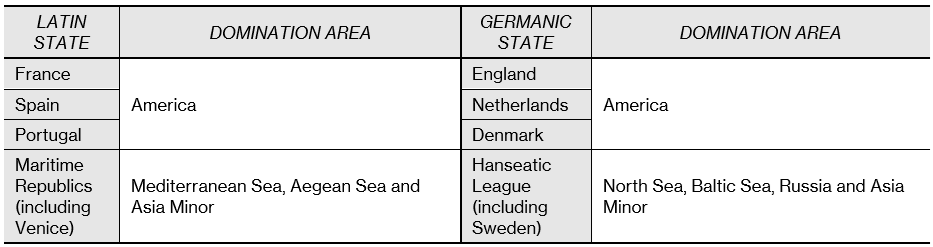
This parallel distribution of the areas of influence of the peoples of the two families made the mirroring of languages and cultures also transplant to the New World:
- Netherlands and Iberian countries colonised the Americas, while Venice and Scandinavian countries influenced the East (Ottoman Empire and Russia, respectively);
- previously, the Scandinavian Vikings had visited America, as well as later the Portuguese visited the East.
- Subsequently, Denmark colonised Greenland and extended its influence to the Near East.
Schematically, we have:

In summary, the Romance and Germanic languages can be systematised as follows:
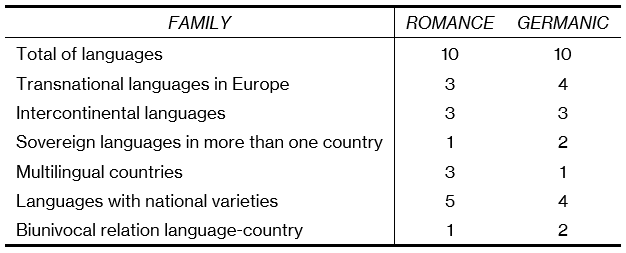
One last curiosity: the sum of the values above equals 26 for both families!
The inverted symmetry of the Western languages
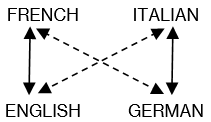
As we have seen, there are three types of symmetry: the “strong”, always vertical; the medium, vertical or diagonal, and the “weak”, vertical, these two of secondary character. Regarding languages that I called “central” (French, Italian, English and German), the strong symmetry is between French and English, as well as between Italian and German. However, many secondary phenomena approach sometimes French to German, and English to Italian. Schematically, we have:
On the other hand, the languages I called “peripheral” (all others of both families) follow the central ones in a peculiar fashion. In terms of phonetics and grammatical structure, the Iberian languages, Venetian and Romanian resemble Italian, while Occitan and Romansh are closer to French. In contrast, the Scandinavian languages, Icelandic and Scots are aligned with English, whereas Dutch and Luxembourgish are close to German. This is what I call reverse or inverted symmetry: while the vertical symmetries connect each language to its mirror, the diagonal create differences that prevent a family from being just a copy of the other. Schematically:

However, there are exceptions to this scheme. As can be seen, the vertical connections between Occitan and Scots, and between Venetian and Dutch, are weak, while the diagonal between the Iberian languages are medium. What does that mean?
As a matter of fact, there are few common points, in terms of phonetics, vocabulary and grammar, between Occitan and Scots. In practice, what can be said is that Provençal is for French as Scots is for English. The same reasoning applies to Venetian and Dutch in relation to Italian and German, respectively. That is what makes these languages correspond.
On the other hand, it is not always possible to establish a biunivocal relationship between each Iberian language and another Scandinavian. Most often, a feature present in more than one Iberian language is also present in one or more Scandinavian languages, while it is rare or absent outside the two peninsulas — which would prove specularity. In other words, we cannot say, except in certain cases, that each Iberian language has an exact counterpart in Scandinavia, but the Iberian languages as a whole are mirrored in the Scandinavian as a whole. (I will deal further with this issue in another article.)
Perhaps these relationships are all a bit abstract for the beginning reader, especially because there is no space here for long examples. Articles on languages contained in this web portal will make these processes clearer. I hope that the cases described will convince you of the veracity of these phenomena.
__________
[1] Check out https://en.wikipedia.org/wiki/S%C3%A1mi_people.
[2] The microstates are: Andorra, Monaco, San Marino, Vatican City, Liechtenstein, Malta and Man.