
I hesitated a lot in producing this portal, as I know that something new always creates opposing reactions and comes up against all sorts of resistance, especially when it goes against certain deeply-rooted convictions.
In deciding to publish my ideas and findings, I am aware of the criticism I am exposing myself to, as I know that many will certainly accuse this work of being unscientific, visionary, etc. Actually, I am not even sure that my approach is scientific all the time, but it does not matter: I have long felt that I had discovered something great, something truly important, something that had always been before our eyes, but that we had never had the breadth of vision to perceive.
In fact, this is not a linguistics, history, geography or anthropology portal, but the study I undertake here crosses all these domains and, at the same time, transcends the frontiers of the current human sciences, amalgamating them in the study of an object that is at once particular and broad: Western Europe and the Americas, their peoples, their languages, their civilisation, that today is the civilisation of the world, which is why such an object deserves so much attention.
But my study sometimes extends into the realm of natural sciences, physical geography and geology, for example. What I seek to do here can be called a “holistic science”, if the term is appropriate.
In most scientific texts, a series of concrete pieces of evidence are used to arrive at a hypothesis. This is called the inductive method. Here, I chose to do exactly the opposite: formulate a hypothesis from the outset and then present the evidence that should support it. Obviously, this was not the research path I took, but this is the path I decided to lead the reader to follow, and I believe that adopting this approach is fully justified. Firstly, the evidence is much more numerous than the conclusions to which it leads, which would make my reader terribly impatient. Secondly, there are times when it is necessary to use the basic hypotheses to explain certain particular phenomena. Thus, as in a novel in which the writer chooses to begin his narrative at the end and then, in flashback, show how he got there, the best solution for me was to present the hypotheses a priori. Finally, it should be understood that the choice of this path is much more a question of the author’s personal idiosyncrasy than of method.
-*-*-
When I dropped out of physics and decided to study linguistics at the University of São Paulo, I had in mind to devote myself to the study of an issue that had been occupying my attention and whetting my curiosity since my teenage, when I began to study languages on my own: the striking similarity, an almost specularity, between languages and peoples of the north and south of Europe. What caught my attention at first was the similarity of vocabulary and spelling between French and English (which fact, as I learned later, is due to the strong French influence that the British Isles have undergone for over three hundred years, the result of the Norman invasion of England in 1066). Nevertheless, I noticed a number of other analogies in phonetics, morphology and syntax of the two languages that were not explained by simple political or cultural influence of one over the other.
Next, I noticed that these analogies were not restricted only to the two languages, but I began to realise structural similarities (not always properly resemblances) between Italian and German, and later between the Iberian and Scandinavian languages, to finally realise relations between Romanian and Icelandic. Moreover, I was gradually noticing that similarities, coincidences, mirroring, or any other name given to this phenomenon, also occurred among those pairs of countries with regard to history and geography.
But when I say that there are analogies between the French and the English languages, or between Italian and German, we need to clarify what exactly that means. In the case of French and English, of course there is much more than simple analogies, there are real similarities, especially in the vocabulary, which is explained by the direct loan of French words to English: point, money, order, direction, service, liberty are nothing more than point, monnaie, ordre, direction, service, liberté, etc.
However, even before the Norman invasion, the English language already had some characters analogous to the French language, especially at the phonetic level. From the arrival of the French invaders, English became even more like!
In contrast, between Italian and German, or between Spanish and Swedish, one can hardly talk about similarities, but analogies. In fact, a text in Italian and its translation into German are quite different, both in spelling, vocabulary or grammar. What draws attention in these languages are not the (few) similarities, but the systematic differences.
For example, Italian spelling is different from German, but the typical Italian process of eliminating h, keeping it only in digraphs ch and gh, has its counterpart in the German process of replacing c by k or z, except in digraphs ch, sch, and ck. The Italian and German tendency to replace Latin ti with z while French and English replace it with c is another example: Lat. essentia → Fr., E. essence; It. essenza, G. Essenz. (All phonetic, graphic, lexical and syntactic peculiarities of all these languages will be dealt with in specific articles; the reader can be sure that these few examples are just the tip of the iceberg.)
Therefore, saying that two events are analogous (or symmetrical, or synchronous) does not mean that they are similar, but that there is a relation between them, just as a mathematical function that to each value of the variable x associates a corresponding value of y, not necessarily equal to x but which is obtained from x by the application of a particular rule, a formula. For this reason, we can see symmetries between facts seemingly without any connection to each other, and therein lies the great subtlety of research in this field: systematic differences will interest us much more than properly similarities, although these are also relevant. The fact is that similarities are evident, and their general explanation is usually obvious, whereas the systematic differences can only be found in a fairly large number of cases.
Using the example of mathematics, the conclusion that 1 equals 1 is trivial, but if we have the pair (1, 2), we cannot know in advance what the relation is that from 1 leads to 2, that is, what the mathematical function is that, given x = 1, produces y = 2 (in simpler terms, in which way, starting from 1, we reach 2). After all, both y = 2x and y = x + 1 or y = 3x – 1 are satisfied by the pair (1, 2). Thus, only by testing other pairs of numbers can we decide which equation it is all about.
Similarly, symmetries can be realised only in that the differences between the compared elements are systematic, that is, in that one can establish a proportional relation such as “A is to B as C is to D”. Although the elements A and B are different, the nature of this difference is the same found between C and D. The systematic repetition of this kind of difference is what gives us confidence to claim that there is an analogical relation between the language containing elements A and C and the language containing elements B and D. (I am speaking of languages, but the same reasoning applies to dates, historical events, topographical, demographic, cultural phenomena, etc.)
As for the nature of these symmetries, in most cases the cause is unknown in terms of traditional science. All the analysed facts seem to indicate, however, that the history of Western Europe, including therein the geological history of the continent — long before the human presence in the region — cannot be the result of blind chance, but neither seems to result from known deterministic laws. (Were that the case, the same analogies would be found everywhere; however, Western Europe is the only testimony on our planet of the occurrence of this phenomenon.) It must therefore be the result of the action of some kind of principle whose nature is unknown, belonging perhaps to some more subtle sphere (quantum, complex, holistic) of reality, that science certainly heads in some way to explain. (A caveat: though respecting mystical and spiritual visions, I have an absolutely sceptical and rationalist stance; the fact of not finding in the immanent world answers to my questions does not allow me — or at least does not attract me — to search for them on a transcendent level.)
As in a mirror, the real and the reflected image are equal, but at the same time reversed. Comparing the two images — the real object and its reflection in the mirror — we realise an overall symmetry, which means equal size, shape, colour and texture, but reversing position: what in the object is on the left in the reflection is on the right, and vice versa. Something very similar happens when we confront all the Latin countries of Europe (conventionally called Romania) and the Germanic countries (conventionally called Germania): same east-west extension, the same relative position between analogous countries, etc. At the same time, Germania looks like a mirror image of Romania – or rather a negative image. Prior to better explain this metaphor, let’s borrow from biology the concepts of analogy (similarity of form) and homology (similarity of substance). Given a glass cup and a glass jug and a ceramic cup and a ceramic jug, I can say that the two cups are analogous, as well as the two jugs, as they have the same form (and the same function). In turn, the glass cup and the glass jug, as well as the ceramic cup and the ceramic jug, are homologous because, although different from each other in form and function, they are equal in substance (and therefore in source).
In a scheme such as
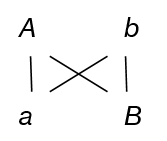
A and a are similar to each other (they represent the same letter), as well as B and b. But the homologous of A is B (because both are capital letters), and the homologous of a is b (lowercase). Like a photographic negative, the forms are analogous to the positive, but the colours are reversed. Therefore, analogous countries, peoples, or languages have similarity of form with each other but difference of substance. In contrast, homologous countries, peoples, or languages have similarity of substance, but difference of form.
Based on this principle, there are two types of symmetry, or mirroring: by analogy and by homology. The first type, by far the most frequent and sometimes the only existent, I call primary or vertical symmetry; the second, I call secondary or diagonal symmetry. As a matter of synonymy (and to avoid the monotony of the text), I can sometimes employ the terms direct or cross symmetry in place, respectively, of vertical and diagonal. (If in doubt, see the GLOSSARY in this portal.)
In the vast majority of cases there is vertical symmetry, and possibly also diagonal. But we cannot underestimate the importance of the latter: if only there were vertical symmetries, we would not have specularity but identity (e.g., a positive picture and its copy). It would be as if French and English were the same language. It is the game between the vertical and diagonal symmetries that makes two languages or countries specular (like France and England) without being identical (like France in relation to itself) or completely unrelated (like France and Japan, for example).
Between Fr. assistance and E. assistance there is vertical symmetry, as well as between It. assistenza and G. Assistenz (case a). Between Fr. brise and G. Brise there is secondary symmetry, as well as between E. breeze and It. brezza (case b). Among the forms Fr. fièvre, E. fever, it. febbre and G. Fieber there are both types (case c). (Another example of this type would be Fr. ligue, E. league, it. lega and G. Liga.) The claim that French is the analogue of English and Italian is the analogue of German is due to the fact that relations a and c are much more frequent than b.
The greater or lesser specularity between two languages may be deduced from a kind of rule of three. If we make, for example, a comparison of the phonetic, lexical, and grammatical aspects of French and Italian, we will come to a set of abstract relations such as “French A Þ Italian B”. Now, recognising that English has specular characteristics in relation to French (let’s call them A’) and applying the same abstract relations that lead from French to Italian to deduce what the fourth language of that square would look like, we would have a reasoning of the following type: A : B :: A’ : x; therefore, x = B’ (read as A is to B as A’ is to x, therefore x equals B’). If, by applying this proportionality rule, we get a language very close to German, then it is because German is indeed mirror language of Italian. Therefore, as there is an analogy between the ratios A/B and A’/ B’, there is also between A/A’ and B/B’, which closes the circuit.
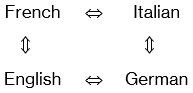
The symmetry between the two families of peoples is so big that a way to test it would be inventing a third family of countries whose history, geographical layout, and languages kept the same symmetries in relation to the Latin and Germanic families as they have with one another. Of course, this playful creation exercise would have no practical purpose but to prove the existence of a fabulous specularity between Latin and Germanic countries. (About this, read my article Supersymmetry and language creation).
Western Civilisation, now also known as Global Civilisation, emerged in Western Europe around the 5th century AD and is the result of the mixing of several cultures that historically preceded it: that of the Greeks, with their rationalist and human-centred worldview; that of the Romans, who unified Europe under a single empire and under the dominance of the Latin language; that of Christianity, which, born in the Near East from Judaism, became fundamentally the religion of the Romans; and that of the Germans (or Germani), who invaded and destroyed the political unity of Rome, but, having at the same time adopted its culture and religion, profoundly influenced this new Europe that was then emerging. In fact, Western Civilisation began at the moment when Rome — which until then was partly the heir to the Greek tradition and partly the centre of the new Judeo-Christian ideology — began to have more intense contact with the Germans, the so-called barbarians, a contact that was initially peaceful, but later warlike. In fact, Germanic and Judeo-Christian influences occurred in the Roman Empire almost simultaneously, from the first century AD onwards. It was precisely with the fall of the Empire that Germanic culture and Christian religious ideology triumphed over the ruins of Graeco-Latin culture.
But the peoples who actually built this new civilisation were the Romans — Greek and Jewish influences were present indirectly, but not these peoples — and the Germans. The European civilisation that would, from the 15th century onwards and with the great voyages of navigation, colonise the rest of the planet, was fundamentally constituted by these two peoples.
But what draws attention due to its unusual nature and constitutes, by the way, the theme of this portal is the fact that these two peoples organised themselves in the territorial space of Western Europe in such a symmetrical way that almost everything related to them — their geographic distribution, their history, their language, their cultural traditions and even some other more everyday aspects of their lives — constituted parallels of such an order that it is as if each of these groups of peoples (since both the Romans and the Germans were divided with the end of the Roman Empire into several ethnic groups) were the mirror image of each other. Why these two population groups followed and continue to follow such parallel trajectories, to the point that, as we will see, in some cases the symmetry between them presents a mathematically frightening precision, and why this seems to be a unique case in the history of humanity in which such a phenomenon occurs is the subject that I intend to address in this portal. It is true that in other places on the planet other civilisations developed supported by the contributions of various peoples. But nowhere else have these peoples organised themselves in such a similar way that one seems to be a mirror image of the other. For example, Eastern Europe is the result of the crossing of Greek Orthodox Christianity with Slavic culture; Islam is based on the Arab, Iranian, Turkish and other ethnic groups of the Caucasus who adopted the religion of Muhammad; Chinese civilisation spread to Japan, Korea and Southeast Asia; Hindu civilisation encompassed peoples neighbouring India such as the Nepalese, Burmese and some other inhabitants of Southeast Asia. But in none of these cases was the participation of each of the peoples involved as balanced as in Western Europe. In none of these cases were there so many coincidences in terms of historical facts, dates, people, places, linguistic phenomena and so on. Such “coincidences”, in fact, are so numerous and obey such a precise logic that they cannot be attributed to mere chance, since that would be statistically impossible. That is why I prefer to treat them as examples of synchronicity, that is, phenomena that are interconnected at a subtle level, not physically detectable, but still phenomena that have a common cause and, therefore, are not fortuitous. The first scholar to address synchronicity and its influence on our lives was Swiss psychoanalyst Carl Gustav Jung, a disciple of Freud. It is his theory that has served as the basis for my research, but in the present case, it is something much grander than the simple co-occurrence of everyday events, such as two people who want to meet and end up “by chance” going to the same place. In the case of the history, geography, language and culture of the European peoples, synchronicity is not occasional, but systematic, and does not involve isolated individuals, but entire peoples, that is, millions of people over two millennia.
And the most important thing is that this civilisation, initially restricted to the western part of the European continent, spread throughout America, Asia, Africa and Oceania, so that such symmetries today involve, in a certain way, the entire planet. For this reason, studying such a phenomenon does not only mean analysing a curious and intriguing fact, but analysing a fact that concerns, to a greater or lesser extent, all of us human beings.
Given this intricate architecture of coincidences and similarities, we might ask ourselves: is all this the result of mere chance and the blind action of deterministic laws? Could any other Indo-European people who had occupied the geographic space where the Germanic peoples currently live have also developed historical, linguistic and cultural analogies with the Romance peoples, although obviously not the same ones that exist today? This is a difficult question to answer, because we have no way of knowing what would have happened if the initial conditions of this system called Western Civilisation had been different. All we need to do is change a single move in a game of chess to change the entire subsequent course of the game. And since for each move in the game there is an amazingly large number of possible subsequent moves, the number of different games that can be produced from these mathematical combinations tends to infinity. Thus, the trajectory that humanity has traced, as well as the history of each of its civilisations, cultures and even individuals, is the result of a series of coincidences that follow one another and determine the subsequent moves. As quantum physicists say, a real event is merely the fortuitous collapse of one of an infinity of possibilities that will never come to pass. But since what interests us is real history, it matters little what would have happened if Napoleon had won the war: he did not win, and that is all we have. The beauty of the world lies in what exists, much more than in what could exist but we will never know. Potential worlds, alternatives to the real world, are the territory of imagination and creativity, but these also depend on reality to exist.